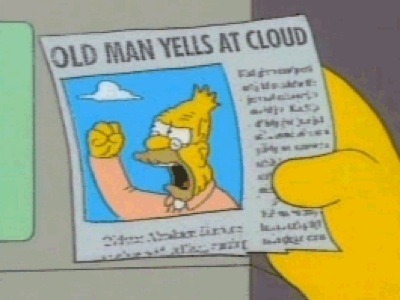
A classic idea, might be the way to go. Just a thought.
Category: blog
-
John Kerry, Still Tolerating It
Right wingers got all squirrelly in their pants the other day because Secretary of State John Kerry had the audacity to say, while visiting Germany, that in America we have “the right to be stupid.” because, UC, saying something like this obviously means that John Kerry thanks all Americans are stupid. Because he’s French, you see. Or something.
(The Breitbart site wrote, ” Portraying Americans as idiots disconnected from the world or reality is a Kerry specialty.” Just as an example. I know.)Well here’s what Kerry actually said.
We live and breathe the idea of religious freedom and religious tolerance, whatever the religion, and political freedom and political tolerance, whatever the point of view. I mean, you know, some people have sometimes wondered about why our Supreme Court allows one group or another to march in a parade, even though it’s the most provocative thing in the world, and they carry signs that are an insult to one group or another. And the reason is, that’s freedom, freedom of speech. In America you have a right to be stupid, if you want to be, and you have a right to be disconnected to somebody else if you want to be. And we tolerate it. We somehow make it through that. Now, I think that’s a virtue. I think that’s something worth fighting for.
You’re goddamn right.
-
It Apparently Doesn’t Take a Psychic
You really have to watch this video of this mystical guy who really seems to know things he could not possibly know about the people he’s giving readings to. Watch to the end to have your mind blown.
http://www.youtube.com/watch?feature=player_embedded&v=F7pYHN9iC9I
-
Starbucks on the Death Star
Why I love the Internet: I thought to myself, they often talk about overseas military bases as being places where a lot of famous chains come and claim territory (the obligatory McDonald’s in Baghdad or what have you), and presumably Starbucks would be one of those chains. So if the United States really did ever build a Death Star as so many folks wanted, how many Starbucks would it have?
Then I thought, this is the Internet. Someone will find out for me. So I took to Quora and asked. Here’s the best answer so far, from Tom Vaughan:Quick back-of-the-napkin math here…
The Death Star is probably going to be a pretty densely populated place; perhaps comparable to Manhattan. According to an article I found on Slate, there are about 400 Starbucks on the island of Manhattan which is essentially a 2-dimensional plane about 87 square kilometers. That equates to about 4.6 Starbucks per km^2
There seems to be some debate amongst Star Wars fans about the size of the 1st Death Star and the 2nd Death Star (read this for a facepalm: Death Star II ) but let’s use 200km wide as the size of the second Death Star (from the Return of the Jedi movie).
I forgot the calculus to do this “the right way”, so what I’ll do is pretend the Death Star is a cube (width^3) and figure out how many 2D “floors” it has on which Starbucks would exist, and then account for the fact that it’s actually a sphere (4/3 * pi * r^3), where r = 100km.
Assume the average deck of the Death Star is… say… 10m high ? Then a 200km high Death Star has 20,000 floors. Each floor is 200km^2 which, using Manhattan density, is 184,000 Starbucks per floor. If it were a perfect cube and all 20,000 floors had 184,000 Starbucks, the whole thing would have 3.68 Billion Starbucks.
Let’s shave off the edges and make it a sphere and I think we just divide our Starbucks by the same ratio as (200^3) :: (4/3 * pi * 100^3). That ratio is about .52, so I think you’re looking at around 1.9 Billion Starbucks in the Death Star.
Looking at that 1.9 Billion number, I realize I may have made some false assumptions about the relative density of the people in the Death Star, or I may have just misjudged just how damn big a 200km sphere is my whole life.
We can make some assumptions about the volume of Tie Fighter docking bays, shield generators, planet-destroying weapons systems, etc. where it wouldn’t necessarily make sense to have a Starbucks but if there’s one thing we’ve discovered on Earth, it’s where there’s an opening, someone _will_ build a Starbucks there.
Thank you.
-
Jack White Turns into John McCain
Before his time, Jack White shakes his fists at the clouds. Via The Verge:
“Getting out of your chair at home to experience something in the real world has started to become a rare occurrence,” White says. “Why go to a book store and get a real book? You can just download it. Why talk to other human beings, discuss different authors, writing styles and influences? Just click your mouse.” (None of these qualify as activities in White’s real world.) “Well here’s what they’ll someday learn if they have a soul,” White says. “There’s no romance in a mouse click. There’s no beauty in sitting for hours playing video games . . . “
“We need to re-educate ourselves about human interaction and the difference between downloading a track on a computer and talking to other people in person. The size, shape, smell, texture and sound of a vinyl record; how do you explain that to a teenager who doesn’t know that it’s a more beautiful musical experience than a mouse click?”
I can’t stop rolling me eyes at this.
Why do we get this kind of whining from artists and writers and the like? Why must it always be framed as one medium being somehow morally superior to the other, as though a vinyl record or a dead-tree book or a reel of film possess some kind of ineffable virtue or godliness?
In what way does downloading a track keep one from “talking to other people in person”?
And while we’re at it, what’s so inherently great about the smell and texture of a vinyl record? I thought the thing about vinyl was that it played music As It Was Meant To Be Heard. What if the exact same sound could be produced on a computer? Would that still not count because an MP3 doesn’t have a smell?
Oh, and of course, the Internet allows for no opportunities to “discuss different authors, writing styles and influences.”
Anyway, with this little tantrum (as some kind of official representative of indie record stores, apparently), White joins the ranks of folks like Prince, the Artist Currently Known as the Guy Who Thinks the Internet is a Fad.
But not John McCain, actually, as my title says. He at least tweets.
This has a touch of Schadenfreude for me, as I never actually liked anything I’ve heard from Jack White, save for one song, and mainly because it accompanies this.
-
Mining Value from Machiavelli: You Need Me On That Wall!
As mentioned in the previous post, which is about something else entirely, I was delighted by a 41-year-old essay in the New York Review of Books by Isaiah Berlin on Machiavelli’s The Prince, a piece that kind of bowled me over.
Berlin makes a case for where he thinks Machiavelli is coming from morally: Is he an evil bastard who thinks it’s fine to just crush people underfoot? Or is he a pragmatist who understands that sometimes you have to be an angel, and other times you have to be a son of a bitch? Is he simply amoral? Berlin says none of the above:There are two worlds, that of personal morality and that of public organization. There are two ethical codes, both ultimate; not two “autonomous” regions, one of “ethics,” another of “politics,” but two (for him) exhaustive alternatives between two conflicting systems of value. If a man chooses the “first, humane course,” he must presumably give up all hope of Athens and Rome, of a noble and glorious society in which human beings can thrive and grow strong, proud, wise, and productive. Indeed, he must abandon all hope of a tolerable life on earth: for men cannot live outside society; they will not survive collectively if they are led by men who . . . are influenced by the first, “private” morality; they will not be able to realize their minimal goals as men; they will end in a state of moral, not merely political, degradation. But if a man chooses, as Machiavelli himself has done, the second course, then he must suppress his private qualms, if he has any, for it is certain that those who are too squeamish during the remaking of a society, or even during its pursuit and maintenance of its power and glory, will go to the wall.
This, according to Berlin, is what has been blowing people’s minds for centuries: Machiavelli isn’t talking about one moral system, he’s talking about two. Two systems that have absolutely nothing to do with each other, both pursuing ends that are justified only within their own systems. You can have men (and in this context, they’re only talking about men) who live in a traditionally “moral” way (Berlin refers to this as “Christian” morality), valuing altruism, sacrifice, and a kind of spiritual wholeness; and you can also have princes who get shit done however they must for the good of the state. More Berlin:
If you object to the political methods recommended because they seem to you morally detestable, if you refuse to embark upon them because they are . . . too frightening, Machiavelli has no answer, no argument. In that case you are perfectly entitled to lead a morally good life, be a private citizen (or a monk), seek some corner of your own. But, in that event, you must not make yourself responsible for the lives of others or expect good fortune; in a material sense you must expect to be ignored or destroyed.
And woe be the society that is led by such men, because, the argument goes, it takes Machiavellians to actually conduct affairs of state and realize what we think of as civilization:
If men practice Christian humility, they cannot also be inspired by the burning ambitions of the great classical founders of cultures and religions; if their gaze is centered upon the world beyond—if their ideas are infected by even lip-service to such an outlook—they will not be likely to give all that they have to an attempt to build a perfect city. If suffering and sacrifice and martyrdom are not always evil and inescapable necessities, but may be of supreme value in themselves, then the glorious victories over fortune, which go to the bold, the impetuous, and the young, might neither be won nor thought worth winning. If spiritual goods alone are worth striving for, then of how much value is the study of necessita—of the laws that govern nature and human lives—by the manipulation of which men might accomplish unheard-of things in the arts and the sciences and the organization of social lives?
This started to make me a little nervous, as though we’re no longer just talking about princes, but any secular person who values the meaning and value that can be extracted from our short, mortal existence, rather than aspiring to some fuzzy posthumous reward.
Reading through this piece, I found myself feeling a kind of sympathy for the Machiavellian position. Trying to erase images of Dick Morris and Karl Rove from my mind, I understood how, as Spock would remind us, the needs of the many outweigh the needs of the few — or the one. And that good can often only be attained by the “prince” behaving in such a way that would not meet the “traditionally moral” smell-test. Just think back over the past 150 years or so of American history, and recall all the morally dubious actions taken by presidents that may have also saved civilization (or not!) or at least maintained American superiority (or not!). The prince’s moral system has no qualms about these actions, it has no room for qualms. The “good person,” meanwhile, looks on in horror.
(I suddenly hear the “sleeps under the blanket of the very freedom I provide” monologue from A Few Good Men in my head. “You need me on that wall!”)
But Karl Rove came back. As I read this passage of Berlin, I felt like I was reading a manifesto of the Republican Party, particularly circa 2003:
Let me cite the best known of his most notoriously wicked pieces of advice to princes. One must employ terrorism or kindness, as the case dictates. Severity is usually more effective, but humanity, in some situations, brings better fruit. You may excite fear but not hatred, for hatred will destroy you in the end. It is best to keep men poor and on a permanent war footing, for this will be an antidote to the two great enemies of obedience—ambition and boredom—and the ruled will then feel in constant need of great men to lead them (the twentieth century offers us only too much evidence for this sharp insight). Competition—divisions between classes—in a society is desirable, for it generates energy and ambition in the right degree.
Religion must be promoted even though it may be false, provided it is of a kind that preserves social solidarity and promotes manly virtues, as Christianity has historically failed to do.
It screams Bush administration, Iraq War, War on Terror, “Jesus is my favorite philosopher,” etc. It reeks of everything the neoconservative GOP, using the religious right as its tool, tried to entrench into the American psyche, and everything they tried to do to Iraq and other parts of the world. America could only be “glorious” at the expense of a conquered state, along with other cowed lesser states. The American public would be kept in line by believing that their Prince was, like them, pious and religious. And we’re all pious and religious, right?
So that caused something of a shudder.
Berlin in 1971 saw the flaws in this approach, and if the Bushies of the 2000s were Machiavellians, Berlin would have clearly seen right through them and disapproved:
[Machiavelli’s] distrust of unworldly attitudes, absolute principles divorced from empirical observation, is fanatically strong—almost romantic in its violence; the vision of the great prince playing upon human beings like an instrument intoxicates him. He assumes that different societies must always be at war with each other, since they have conflicting purposes. He sees history as one endless process of cutthroat competition, in which the only goal that rational men can have is to succeed in the eyes of their contemporaries and of posterity. He is good at bringing fantasies down to earth, but he assumes . . . that this is enough. He allows too little to the ideal impulses of men. He has no historical sense and little sense of economics. He has no inkling of the technological progress that is about to transform political and social life, and in particular the art of war. He does not understand how either individuals, communities, or cultures develop and transform themselves. Like Hobbes, he assumes that the argument or motive for self-preservation automatically outweighs all others.
I have to admit, as I began to cozy up to a little Machiavelli, despite the recall to the Bush era, this passage was the coffee that sobered me up.
Berlin has inspired me to revisit Machiavelli all the same, to better understand what the fuss has been about. Because, as Berlin says, he does bring fantasies down to earth, and champion a political leadership that values the here and now over the imaginary eternal. There must be something to be mined from that.
-
Me vs. the Western Canon
As part of a recent initiative of mine to read a bunch of the foundational classics that I’d so far missed, I finally got around to reading Machiavelli’s The Prince, maybe about a year ago. Though it’s something that has had a tremendous impact on political thought for centuries, I had somehow managed not to be compelled to digest it. Heck, I even got my master’s from GWU’s political management program, which could well be described as a graduate school for Machivallianism itself, now that I think about it, (when the school was established, The New Republic dubbed it “The School for Scoundrels”), but I still missed it.
But despite all this, when I finally read it, it didn’t land with me. I partly chalked this up to the fact that its tenets had, by this point in history, been so thoroughly digested by Western culture, that perhaps there was nothing left to resonate with me — it was all, by now, old news.Suffice it to say, I am not actually convinced by this explanation, as it feels more like an excuse for my own inability to comprehend it, or perhaps, more generously, a problem with my failure to read it with sufficient slowness and closeness.
When I first read Montaigne’s Essays, not too long after I read The Prince, I had a similar experience. But because of the breadth and conversational tone of much of Montaigne, it was not quite so alienating. Some of it I truly loved, while much of it remained beyond my ability — or really, willingness — to grasp.
Then I read Sarah Bakewell’s How to Live, a brilliant exploration of Montaigne the person through the essays, and I found myself falling in love with Montaigne after the fact. But what was I so enamored by, really? Montaigne’s own words, or Bakewell’s interpretation?
I am faced with the same question today. The New York Review of Books has recently put online a 1971 piece by Isaiah Berlin on The Prince and what it tells us about Machiavelli’s morality. The piece is wonderful, long but an easy read, and totally understandable despite its many references to philosophers and academics with which I am not, and likely never will be familiar. Berlin’s explanation of what is so goddamned important about Machiavelli — why he has stirred the centuries-long furor that he has — has made my mind spark with ideas and appreciation. Just as Bakewell has inspired me to return to the Essays, Berlin will drive me back to The Prince. To rediscover.
But I must come back to the central question of this post: Why the hell didn’t these masterpieces of Western Civilization land in the first place? What was I doing wrong?
Some possibilities, a couple of which were mentioned previously in this post:
- I didn’t pay close enough attention, and devote the kind of slow, thoughtful time required of such works, wanting instead to have checked them off my to-read list. (Possible.)
- Having chosen free versions of both works for reading in the Kindle format, I was stuck with public-domain translations that are very old, written in such a way as to feel very antiquated and archaic to me. (Only a slight factor, I suspect, if at all.)
- The ideas contained in these works are now part of our cultural fabric, and don’t resonate because they are at this point entirely assumed or humdrum. (Almost certainly not correct, or else Shakespeare is a phone book.)
- I’m simply not smart enough, or sufficiently educated, to appreciate these works. (Possible on both counts.)
I, being a master of self-loathing, am inclined toward the last bullet in that list, but for the sake of this post, and of giving myself the all-too-rare benefit of the doubt, I have one final possible explanation that pleases:
- Bakewell and Berlin, in their works, served as the teachers I never had, instilling in me an appreciation and excitement for Montaigne and Machiavelli that might have otherwise come from a brilliant college professor.
I went to undergrad for theatre. I went to graduate school for what is essentially a vo-tech for politics — not “political science” or political philosophy, but the practical navigation of the modern political industry. Montaigne and Machiavelli would not appear in these classes, not explicitly anyway. Much as it takes an enthusiastic science teacher in high school to turn a kid into a physicist, or it takes a crazy and overdramatic English teacher to make a student fall in love with literature, I posit that Bakewell and Berlin have been my teachers, and her book and his article have been my classes. And so my eyes were opened, and my mind awakened to what I would have otherwise missed from casual readings.
So maybe I’m not so dumb after all.
No, I probably am. But still.
* * *
Note: I’ll have more about the Berlin piece specifically in a separate post, and I’m considering delving back into Montaigne’s Essays and beginning a new blog project in which I write posts in reaction to each essay. We’ll see. Oh, and my current selection from the Western canon is Burke’s Reflections on the Revolution in France. I am going to understand conservatism if it kills me.
-
Near-Earth Object, Too Close for Comfort
From the NYT report on the Siberia meteor:
“I opened the window from surprise — there was such heat coming in, as if it were summer in the yard, and then I watched as the flash flew by and turned into a dot somewhere over the forest,” wrote Darya Frenn, a blogger. “And in several seconds there was an explosion of such force that the window flew in along with its frame, the monitor fell, and everything that was on the desk.”
“God forbid you should ever have to experience anything like this,” she wrote.
[ . . . ]
Valentina Nikolayeva, a teacher in Chelyabinsk, described it as “an unreal light” that filled all the classrooms on one side of School No. 15.
“It was a light which never happens in life, it happens probably only in the end of the world,” she said in a clip posted on a news portal, LifeNews.ru. She said she saw a vapor trail, like one that appears after an airplane, only dozens of times bigger. “The light was coming from there. Then the light went out and the trail began to change. The changes were taking place within it, like in the clouds, because of the wind. It began to shrink and then, a minute later, an explosion.”
“A shock wave,” she said. “It was not clear what it was but we were deafened at that moment. The window glass flew.”
I can’t imagine witnessing something like this. If I had seen this with my own eyes where I live, particularly when I was living in DC, I believe I would have immediately assumed it was a weapon, that we were being attacked, that we may be about to die.
I almost can’t believe there wasn’t total panic in Chelyabinsk. Those Russians are made of stern stuff.
-
The Bodies of Those Who Happen to Be in the Way
Ta-Nehisi Coates on our perpetual state of war:
The president is anti-torture — which is to say he thinks the water-boarding of actual confirmed terrorist Khalid Sheikh Mohammed was wrong. He thinks it was wrong, no matter the goal — which is to say the president would not countenance the torture of an actual terrorist to foil a plot against the country he’s sworn to protect. But the president would countenance the collateral killing of innocent men, women and children by drone in pursuit of an actual terrorist. What is the morality that holds the body of a captured enemy inviolable, but not the body of those who happen to be in the way?
Good question. Is it the idea that unbearable pain is more immoral than a quick death-from-the-skies? Is it because the calculations for potential blowback work out a certain way? Post-Bush, I think these kinds of issues are far more nuanced than progressives have allowed themselves to believe. I hope our consciences are limbered up, because there’s still a lot more wrestling to do.
-
Is Not the Truth the Truth? – Galileo as Falstaff
Go ahead and let this passage from a wonderful piece on Galileo by Adam Gropnik in The New Yorker blow your mind.
What would Shakespeare’s Galileo have been, one wonders, had he ever written him? Well, in a sense, he had written him, as Falstaff, the man of appetite and wit who sees through the game of honor and fidelity. Galileo’s myth is not unlike the fat knight’s, the story of a medieval ethic of courage and honor supplanted by the modern one of cunning, wit, and self-knowledge. Martyrdom is the test of faith, but the test of truth is truth. Once the book was published, who cared what transparent lies you had to tell to save your life? The best reason we have to believe in miracles is the miracle that people are prepared to die for them. But the best reason that we have to believe in the moons of Jupiter is that no one has to be prepared to die for them in order for them to be real.
Indeed:
What is honour? a word. What is in that word honour? what is that honour? air.
-
Words, Once Said, Can Never Be Unsaid
I can’t help but think that Justin Timberlake, perhaps many years from now, will find himself unable to sleep some nights, haunted by these words:
Bud Light Platinum brings a refined discerning aesthetic to beer that plays well with what I’m doing.
Does it, Justin? Does it really?
-
The Game Should Leave an Imprint
With a few exceptions, I haven’t been into video games in a very long time. Part of that is, of course, being a grownup with a job and a family, which leaves little time for, well, anything. (And I genuinely have no idea how folks with jobs and families can devote the hours they do to these things.) Also, I am usually terrible at them, no matter what I do (with Tetrisphere and Tekken Tag Tournament as notable exceptions). But more to the point, I’ve tended to see them as a waste of time, even if they’re really, really fun.
I found a kind of validation of my way of thinking from video game developer David Cage who gave an eye-opening presentation to the DICE video game conference, as reported by The Verge:“When you think about it, you realize that many games have absolutely nothing to say,” said Cage. “They’re merely here to make you have a good moment, to trigger some adrenaline in your system, and that’s cool.” But Cage stressed the importance of using content to create real meaning. “All real world themes should be used. Anything you’d see in a book or movie or a tv series could be used in a game. Politics, homosexuality… we need to put games at the center of our society and our lives. They should talk about people, they should talk about our world, they should talk about relationships, about society, and games can do that in a very meaningful way.”
“By the time you turn off your console, the game will leave an imprint. You will think about what you’ve seen. That’s what every creative medium should achieve.”
Similar to why I’ve soured on television and even movies, I feel like so many hours can be whittled away on them, and I will have gotten nothing back — even if the show, film, or game in question was fun or amusing or whatever.
But games in particular, they can give even seasoned players, what, 60-plus hours of playing time. Why would you want to waste such a powerful medium on just more shooting and puzzle solving? It’s not even necessary to fill a game with politics or a moral or what have you, but like any great novel or film, shouldn’t the story and the experience enrich you in some way, given all that you’ve put into it?
Truth be told, I’m not entirely sure what that would look like. I tend to look back on, say, Ocarina of Time or Final Fantasy VII as enriching experiences, but even they were more about the wonder of immersion into a fantasy/sci-fi soap operas. Where’s the Tale of Two Cities of video games? It may already exist, and surely my outdated experience would miss it. I wouldn’t have time to play it anyway!
Update: I thought of one that might count, Bastion, which I played on iPad. A game that was gorgeous, original, showed ambiguity about its (somewhat cartoonish) violence, and has a score and soundtrack that is to die for.
-
The Stream of Invective, a Price Well Paid

Wikipedian Brandon Harris takes to Quora to talk about how he felt being the subject of a lot of Internet derision during his famous banner appearances throughout Wikipedia’s fundraising drive. His words were, to say the least, helpful.None of it is real.
There is a stream of invective from people saying that I look like a child molester or a methamphetamine dealer. It’s awful. But it’s not real. I’m none of those things and moreover: none of these people know me. But for every one of those comments, there’s one saying how “hot” I am, or something else equally positive but also shallow. None of those statements are real, either. And it’s important to keep that in mind . . .
I have a passion for the Mission and if a handful of high-schoolers talking shit about me grants me the ability to have real conversations with adults about the Mission, it’s a price well paid.
The abuse and derision I’ve been subject to online in recent weeks has been alarming to me, and as I’ve mentioned, upset the wasp’s nest of my battered psyche somewhat. But Harris’s response reminds me that I believe in what I write, despite all my personal doubts, and that it matters that the message of my posts about how we humans treat each other is heard (coming from me or the many, many others who do the same).
The tone and substance of the crap hurled at me should be valued for what it is: crap. These are dumbasses on the Internet who really think it’s crucial that they put a stop to things like expressions of compassion, empathy, and generosity of spirit. I’m going to try to remember that.

 pav dot quest