-
The Power and Pathos of Optimus Prime

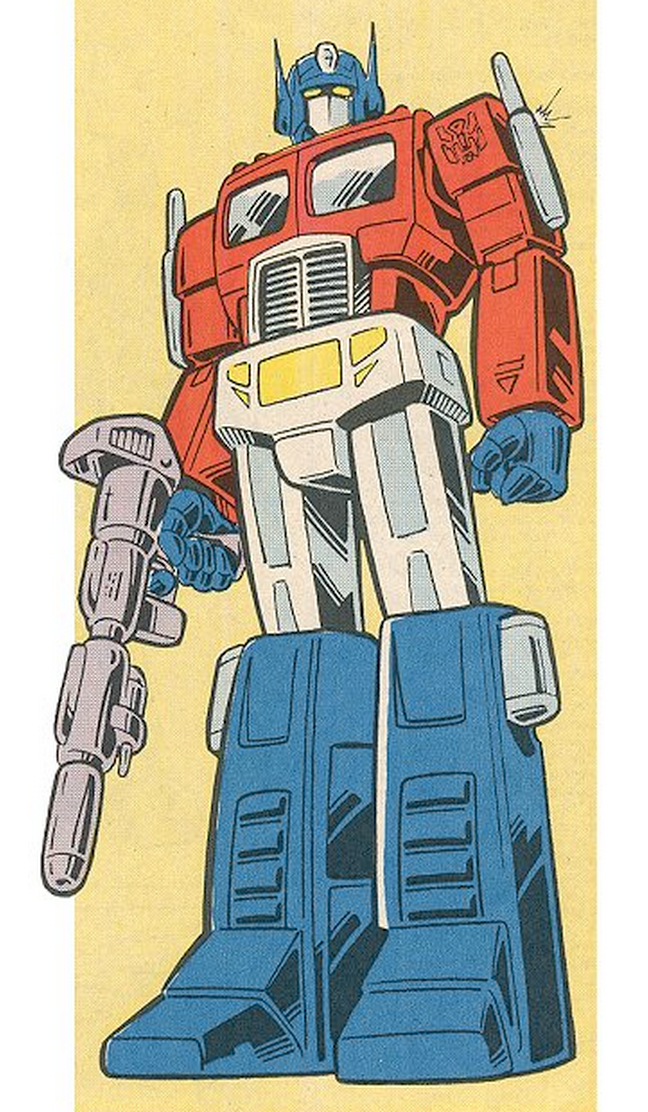
As you might know, I am a great fan of the old-school Transformers, the 1986 Transformers animated film in particular. (I even hosted a whole podcast episode about it.) For all their flaws (which are plentiful), the franchise was a watershed moment for me, introducing me as a child to a kind of storytelling, a style of animation, and a degree of out-and-out violence I’d never experienced, for better and/or worse.What stays with with me more than any other aspect of the franchise, more than the novelty of form-shifting robots or the grandeur of heavy-metal space opera, is the character of Optimus Prime. This is not simply due to the fact that he was the “leader of the good guys,” or that he was strong, or visually striking, all of which are true. But there is a kind of nobility to Prime that permeates every manifestation of Transformers, be it the old cartoon, the animated film, the comic books, or even the recent Michael Bay movies (of which I have only seen the first). Though astoundingly powerful and even deadly, Optimus Prime has always been at the same time almost naive in his idealism, his self-discipline, his personal sense of morality and honor.
My friend Kyle Calderwood directed me to an interview with some of the folks behind the 1980s show and film, and one part stood out to me. Here, voice director Wally Burr described creating the Prime character’s voice with the man who would play him, Peter Cullen:
We were auditioning lots of people for the show, and he was auditioning for Optimus. [Cullen] didn’t have it yet, but he was well known, so he was obviously going to be one of the best candidates. And I was pushing him pretty hard at that audition. And he’s a big guy, a master of everything. And he said “Wally, I’ve got about thirty promos to do for ABC tomorrow, can we back off a little bit?” And I said, “What if we back off a lot and just make Optimus a very nice gentleman who doesn’t shout at anybody, because he knows what the hell he’s doing?” And so Peter softened his voice, and became noble! Instead of a shouting boss, he was noble. And he credited me once at a convention when someone asked him how he created the character. He pointed to me at the back of the room. He agreed with me that we could soften him, yet still make him a very strong character. And he’s been doing it for over thirty years now!
It feels kind of obvious thinking back to it now, but it makes sense that this decision by Cullen and Burr to “soften” the character’s delivery, rather than voice him as some kind of ultra-macho task-master, made all the difference in making Prime a character with a palpable pathos. It spoke to Prime’s strength that he didn’t feel the need to constantly project it. It spoke to his authority that he didn’t need to reinforce it. It spoke to his determination that he didn’t waste effort making grand protestations about it.
I am reminded of Optimus Prime’s entry in Marvel Comics’ Transformers Universe series, a kind of Transformers encyclopedia in comic book form, and even though I last read them at the age of 9 or so, the closing lines stuck with me. I rediscovered them archived here at this website, where, under the entry for Prime’s weaknesses, it says:
Otherwise the only weakness he could be accused of having is being too compassionate and concerned about the safety of others. He would be a more effective military commander if he were more ruthless, but then he wouldn’t be Optimus Prime.
-
Here Come the Apologetics from “Some” Mars One Candidates
The true believers of Mars One have begun to respond to the criticism the program is facing, most specifically from the excellent investigative work of Elmo Keep, whose pieces I have now cited twice on this blog. Yesterday, I wrote about how Keep’s reporting reveals that Mars One is beginning to look less like a noble scientific enterprise, and more like a profit-seeking rapture cult.
Today, I am directed to a rebuttal piece that is part group-response from Mars One candidates, and part personal response from candidate Oscar Mathews Correa. I’ll get into a few of its specifics in a bit, but it’s more or less what you’d expect, an attempt to correct or put in context the problems that Keep’s reporting has raised.Now, to be entirely clear, I should say that the first part of the article is allegedly by a group of Mars One candidates, as no names are given. Rather, it is attributed to, literally, “Some Mars100 Facebook Candidates.” So right off the bat we’re in sketchy territory, as no specific person is willing to put their name to it (other than Correa, I assume).
The very first problem with this piece is that it calls Keep’s criticisms a “conspiracy theory” right in the title, when in fact it’s the opposite. Keep implies no conspiracy, there are no wheels-within-wheels nor powerful, shadowy entities pulling any strings. If there were, the program would be more successful. But one could certainly infer (as I do) a scam. It is more accurate to say that the rebuttal’s authors are perceiving a conspiracy against them, when of course none exists.
Let’s cover some of the points made by “Some Mars100 Facebook Candidates” in the first part of the article. This will by no means be exhaustive, but touch on some of the points that stood out to me. In Keep’s latest article, former candidate Joseph Roche says that Mars One’s training and expertise requirements fall well below those required of NASA astronauts. To which the “Some” respond:
The Mars One project is very different to a typical NASA mission, and therefore has very different requirements for its astronaut candidates. The Mars One candidates would be primarily colonists, not pilots. It is likely that course corrections and landing procedures will be automated — for uncrewed as well as crewed spacecraft.
There will be 10 years of training between selection and launch, which absolutely does compare to NASA’s level and depth of training. This training might cover emergency manual control of spacecraft if applicable.
“It is likely that…” and “This training might cover…” – why don’t they know? A program designed to send colonists to Mars for the rest of their lives doesn’t know what it will train them for? Or is it that the “Some” haven’t been told? Why not?
Keep reports that the alleged primary source of funding (which would have to be enormous since we’re talking about colonists on freaking Mars), supposedly a TV production company, bailed on the program. The “Some” say all is well, because:
The primary source of finance is to be an investment firm in the first stages of the mission (leading up to and including the first manned mission). The documentary and live broadcast aspects of the project are expected to bring in revenue at later stages of the project. Mars One is in talks with both an investment firm and a new production company to take over the documentary aspect of the project. Collaboration with Endemol [the original production company] was reportedly ended as they were unable to reach an agreement over the terms of the contract.
Which investment firm? What firm on Earth is willing to be the primary source of billions of dollars for this vague project? And it is vague, even in how the “Some” describe it. Funds are always “expected,” and Mars One is always “in talks” (remember the “meetings” from my Underpants Gnomes post). It’s all a lot of promised milestones, none of which have been reached, and by their own admission, at least one has fallen through. Why is this all so murky?
That’s my overall impression of the rebuttal from the “Some”: It’s airy and hangs its assertions on “talks” and expectations, with little to nothing that is solid, decided, or in place.
Moving on to the second half of the piece, we have Correa’s personal response (which is itself apparently an extract from another article somewhere else). Like the “Some” response, it doesn’t begin well either:
That rascally Elmo Keep is at it again.
“Rascally”? Yeah, I’m really ready to take this person seriously. Note, too, that Correa refers to Elmo Keep as “Elmo” and not by her surname, as through they’re buddies.
Correa, overall, seems to believe that the bad impression now being given by Mars One is the result of some “missteps in public relations,” not to any problems with the facts of the program.
He plays a cheap emotional trick early in his response by putting a lot of emphasis on the early medical screenings undergone by candidates, as though this made up for the thin application and paltry interview process, and drops in that the medical screenings “surprisingly revealed some candidates with cancer, potentially saving their lives.” You see? Mars One is already saving lives! Just with its application process! Only a monster could object to saving people’s lives from cancer.
Correa seems to me to be fixated on the supposed agendas of various parties rather than the legitimate criticisms of the program. He writes:
For example, in one televised interview done in the Miami broadcast area (en Español), a NASA engineer attempted to refute some MarsOne mission plan elements by saying we would never get to Mars until we could land 40 metric tons on the surface. This is not true. Yet he receives airtime because he works at NASA, and of course they have their nascent “Mars missions begin on the ISS” agenda to promote.
Ah ha! You see! It’s a conspiracy by NASA who want to stop the Mars One mission from succeeding, because what they really want to make sure humans get to Mars the NASA way.
And yes, he receives airtime because he works at NASA. Because he actually has a chance of knowing what he’s talking about. He might actually bring facts, expertise, and experience to the discussion.
Unlike, well, “Some.”
I wonder if we’ll see more of this. This particular article isn’t egregious, but it smacks of defensiveness, released to fill the dead air coming from the Mars One organization, and its lack of substance only increases my already-deep skepticism of the project. More worrying is how it reads like religious apologetics. They believe it will all work out, because it’s been promised. And the promised land itself, Mars, beckons so strongly, and feels to them to be so close.
I hope too many people don’t get screwed too badly.
-
Mars One is Amway-Meets-Heaven’s Gate
In November I wrote about an investigative piece by Elmo Keep on the Mars One initiative, which is supposed to be screening candidates for a one-way mission to Mars in the next decade. Go read that post to get caught up. (And read all of Keep’s original article, which is amazing.)
In my post, I compared Mars One to the Underpants Gnomes of South Park:So to sum that up in Underpants Gnome terms:
- Hold meetings.
- Get feedback from meetings.
- ???
- Send humans to Mars.
In other words, Keep’s reporting showed that at best, Mars One is a well-intentioned idea, as I put it, built like a house of cards. At worst, it’s a weird and cynical scam, the goal of which is unclear.
Alas, I think the needle may be tilting strongly toward the latter.
Keep is back with a follow-up piece, in which she profiles Mars One candidate (and top-100 “finalist”) Dr. Joseph Roche. What he reveals is that Mars One is less of an Underpants Gnome project, and more of a for-profit cult. From Keep’s piece:
“When you join the ‘Mars One Community,’ which happens automatically if you applied as a candidate, they start giving you points,” Roche explained to me in an email. “You get points for getting through each round of the selection process (but just an arbitrary number of points, not anything to do with ranking), and then the only way to get more points is to buy merchandise from Mars One or to donate money to them.”
“Community members” can redeem points by purchasing merchandise like T-shirts, hoodies, and posters, as well as through gifts and donations: The group also solicits larger investment from its supporters. Others have been encouraged to help the group make financial gains on flurries of media interest. In February, finalists received a list of “tips and tricks” for dealing with press requests, which included this: “If you are offered payment for an interview then feel free to accept it. We do kindly ask for you to donate 75% of your profit to Mars One.”
It’s disgusting, isn’t it? Get people to sign up to be “chosen” for a mythology-worthy (and mythical) voyage to martyr themselves for science and the human race and whatnot, and thereby pressure them to pay into draping themselves in the brand, and funneling their own money back to the project. The candidates, one presumes, really want to be chosen for the mission, to be seen as enthusiastic, committed, and worthy, so they buy into the “points” system as a way to show their devotion. It sounds like Amway meets Heaven’s Gate, or a short-term Scientology. It’s a snake oil rapture story dressed up as noble science.
And as Keep points out, the mainstream media coverage of Mars One has been almost entirely uncritical. How can it be that there’s been only one journalist who’s bothered to do more than be awestruck by the project’s audacity?
Religion often promises immortality and, at its worst, preys upon people’s need to feel a part of something greater than themselves, all for the enrichment and empowerment of those pulling the strings. Mars One thinks it found a way to do that without the need for a deity, without an invisible heaven. Instead, it just pinpointed Paradise as the dusty red planet 140,000,000 miles away, and held out its collection plate.
-
Now I Wire Me Up to Sleep
You know how when you’ve had a good night’s sleep, you wake up the next morning rested, refreshed, and ready to start your day? Well, I don’t.
In fact, I have never felt this way. Regardless of how many hours of sleep I get, whether I remember dreaming or not, or whether or not I’ve snored, had to go to the bathroom, been interrupted by my kids, or had nothing happen whatsoever, I awake every morning feeling crappy, exhausted, tight, cramped, and less than pleased to be alive. For years, I presumed this is how everyone felt. You know, getting up sucks.I used to be an incurable insomniac. Most of my life, I’ve been a severe night owl, unable to sleep at a decent hour even if I wanted to, even if I was very tired. My brain, unable to shut itself down with worries, anxieties, and maybe a hope or wish or two, would churn and churn, keeping my lying awake.
This started changing when I moved from a career in theatre to one in politics and the nonprofit do-gooder world – getting up at 4am every morning to begin The Note at ABC News or getting to the Hillary Clinton campaign headquarters in time to monitor six morning news shows at once are sure-fire ways to make one too exhausted to indulge in insomnia. By the time I had kids who daily woke us up at ungodly hours, insomnia stopped being a problem. I still stay up kind of late (having a battle with sleep), later than my wife certainly, but once I’m sleepy, that’s it, I fall asleep.
But again, regardless of the duration of that sleep, I feel like garbage every morning. My wife and my doctor agreed, it was time for me to get a sleep study done.
For those who don’t know what this entails, it’s where you sleep in a room for a night, monitored by a technician, who uses various wires to track your various biological readings, and also just watches you as you do whatever it is you do while sleeping; tossing and turning, snoring, etc. Fine, I thought, at least it’d be a night of peace to myself.
At first, however, my insurance company wouldn’t approve a full study. Instead, they merely approved an at-home test where I stuck some tubes to my nose and a pulse monitor on my finger to see if I stopped breathing overnight. I didn’t stop breathing. Nothing else learned, of course.
So after being pressed by my sleep specialist, the insurer capitulated and agreed to cover the full in-lab study. It would still be very expensive for us, going toward our deductible, and I was ready to nix the whole thing, but my wife Jess insisted that it was worth it. I, too, capitulated.
This all took months, I should note. Because we have the greatest health care system in the world, you see.
I showed up at the clinic at about 9pm with my pajamas, a book, my phone, and other necessaries. The sleep technician was a middle-aged fellow, short (my height), stocky, gray-bearded, and donned in light blue scrubs. He greeted me brusquely at the door, and hurriedly pointed me to my room, which was a kind of cross between an exam room and an inexpensive hotel room. There was the bed, the TV, a sink, towels and toothbrush, and other medical-looking objects I couldn’t identify. I dropped my stuff, and filled out the forms the tech instructed me to.
Turned out the tech was managing several sleep tests at once, and this is the usual way of things. When he finally returned to get me situated, he was actually quite friendly and down to earth.
The long and the short of it was that once I was changed into pajamas with teeth brushed and other bedtime rituals completed, it was time to wire up. Several electrodes were strung about my body underneath my clothes, and some cold, reddish goo (I think he called it “liquid sandpaper”?) was roughly applied to where they’d be stuck. The electrodes pinched quite uncomfortably, but I got used to it after a while.

I should state here that it seemed that one was more or less expected to watch cable TV while all this was going on, because the wiring took quite a while, and there was also a lot of waiting around while the sleep tech attended to other patients. I haven’t had cable in years, and being exposed to its buffet of offal was slightly horrifying. No wonder this civilization’s in the shitter. Anyway, I eventually found, and left on, a block of Law & Order reruns.
The tech came back and began to wire up my head and face. There was the goo, except more of it in order to get the electrodes to stick to my scalp through my hair. I also had the tube-thing placed to my nose again and the pulse monitor on my finger. I was utterly streaming with wires, it was absurd sight to behold. I’d be tethered to a box to which all the wires were connected, which was itself hung next to my pillow by the bed. I’d have a range of movement of a couple of feet or so, enough to move around in my sleep, but not to leave the room. If I’d need to use the bathroom during the night, I’d have to call in the tech to unhook me, and then hook me back in. (I didn’t, thankfully.)
Once wired, the tech left the room and then ran some tests, speaking to me through an intercom, asking me to breath in different ways and move different body parts, probably checking to see that he was able to monitor all he was supposed to. Then, he more or less told me to do what I liked until about 11 or 11:30, and then hit the hay.
I turned off Law & Order, read a little Treasure Island on my phone, and then decided to just get this whole thing started. Off went the phone, and I “went to bed.”
Now, I should say that before all of this, other folks I’ve known who’ve had sleep studies told me how the whole experience was overall a pleasant one, that the wires and things didn’t impede sleep, and that the overall atmosphere lent itself to a quick trip to slumber.
Nope!

Remember the old insomnia? It was back, with a vengeance. My brain was on overdrive, crunching on myriad miscellaneous problems, anxieties, and regrets. The electrodes began to feel pinchy again, and the tangle of wires made it very difficult to find a comfortable position, obstructing some of my usual postures. Twice the tech had to come in and replace some that had come off in the midst of my writhings. I was too hot, I was too cold, I was too cramped, and on and on.
I also kept worrying about how my inability to sleep would affect the study, and was constantly aware that every sigh I made, every positional adjustment I attempted, and every snore or sound a made would witnessed and noted by the tech.
I knew I had to get this under control and get at least a modicum of sleep, or this would all be for naught. I decided to choose a favorite album and imagine it playing from start to finish. As best I could, I played in real time Ben Folds’ Rockin’ the Suburbs, all in my head. When I lost track of the songs and drifted to other sleep-impeding thoughts, I’d go back to the album. It helped.
But it wasn’t a cure. I still struggled to get comfortable, to stop thinking, to manage the rat’s nest of wires. It seemed like hours were passing, but of course I couldn’t know for sure. I must have drifted in an out of sleep many times, having no concept of the actual passage of time.
Finally, when the tech came back in to get me up at 5am, I could hardly believe the entire night had passed. I felt truly awful and exhausted. My first words to the tech when he came in were, “Holy crap.” At the very least, I was given some coffee from a Keurig machine. It was awful, but it was coffee. I changed, filled out another couple of forms, and trudged out into the dark morning, where, of course, it was snowing. Again.
I’ll know something about the results of my study in the next few days, I’m told. I hope it reveals something, anything that will improve my well-being and justify the expense and overall unpleasantness of this whole experience.
I’m told that it could be that one thing that could happen is that they may want to try CPAP (continuous positive airway pressure) machine at some point. That would mean another night of sleep-study, but with the CPAP mask added to the mix. We don’t know yet.
I’m so excited I may lose sleep over it.
-
My Son and Papa Dreadnoughtus

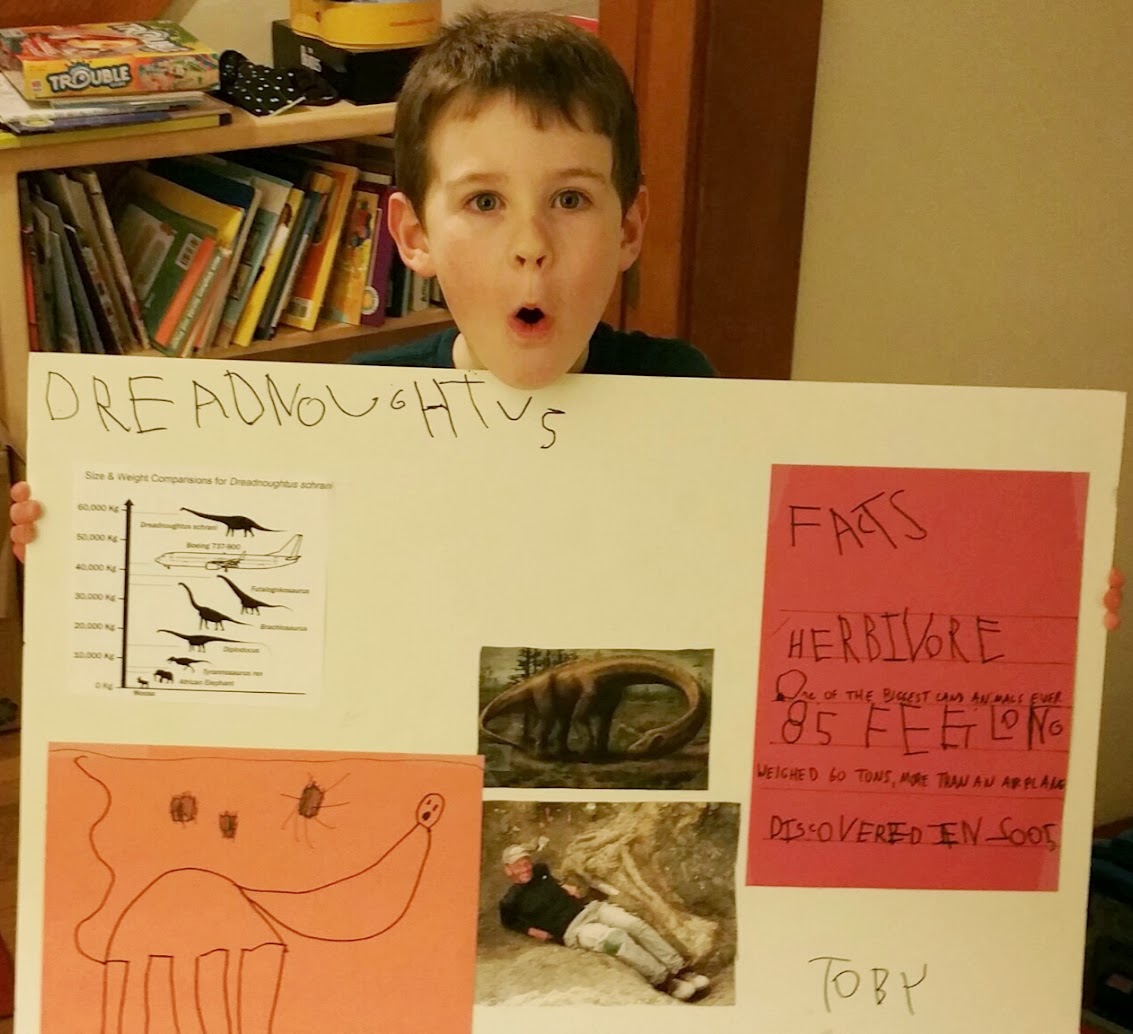
You may recall that last year they announced the discovery of a dinosaur species which they called Dreadnoughtus, thought to be the single largest land animal to ever live. Cool, right? Suck it, Argentinosaurus!Anyway, my 5-year-old son has a project this week in his preschool class on dinosaurs, his favorite subject. He had to choose one to report on, and build a poster based on what he learned. Well he already knows gobs of facts about all manner of dinosaur species, so in order to up the ante and challenge him a bit, we chose, you guessed it, Dreadnoughtus.
He was really enthusiastic about it, he knew he’d be the only kid to choose it, and he threw himself into learning new facts about it, and especially drawing his masterful picture.
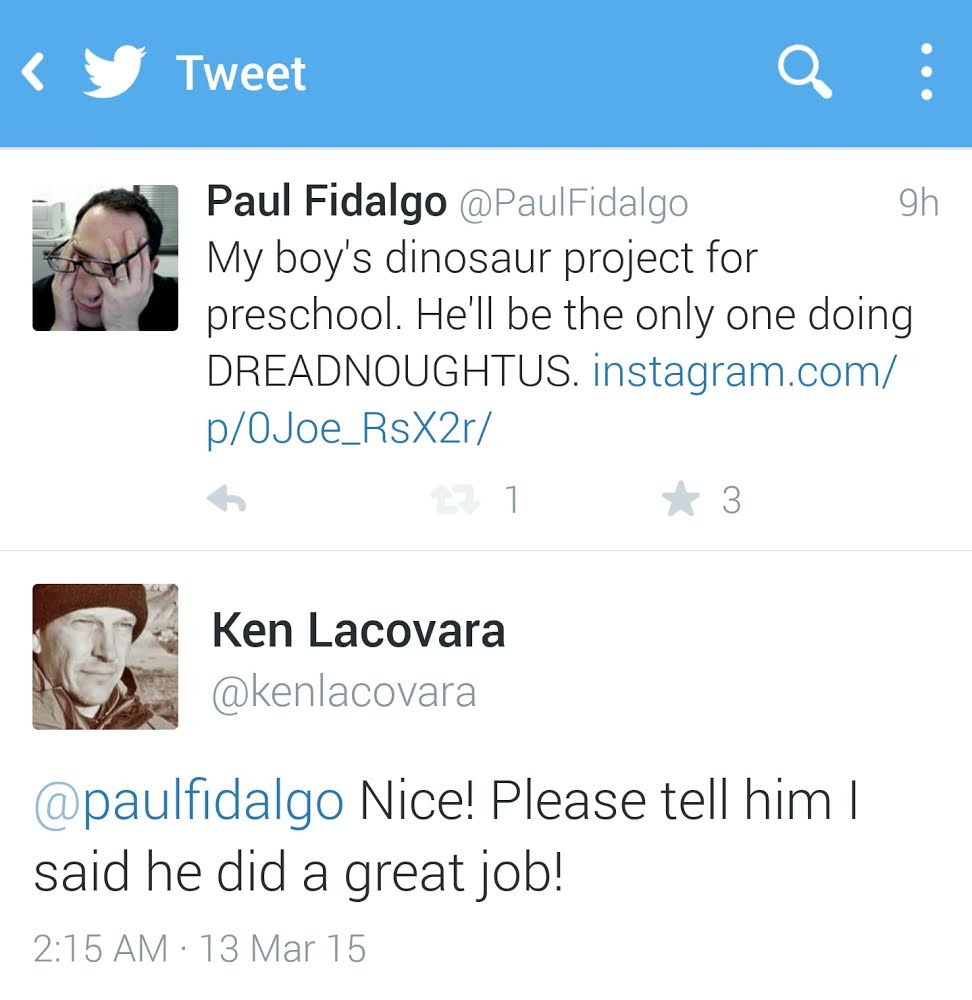
I snapped a picture of my wonderful boy and his project, and shared it to the inter-social-webs. And guess who responded to the tweet? None other than paleontologist Ken Lacovara, the paleontologist who discovered Dreadnoughtus! (He describes himself in his Twitter bio as “Papa to Dreadnoughtus.”) He’s the guy laying next to the fossil in the picture on my son’s poster above. He tweeted:
Nice! Please tell him I said he did a great job!
And on my contention that my boy would “kick those other kids’ [projects] butts,” Lacovara said:Totally
I echo what my wife Jess said about this: It’s this kind of thing that’s so wonderful about the social Internet. That my preschool-age son could excitedly work on a project about a dinosaur, and almost instantly be encouraged and congratulated by the very person who discovered it.
Anyway, thank you, Dr. Lacovara!
-
To Persist, to Ponder
Neurosurgeon Paul Kalanithi died on March 9 of lung cancer. He was, as I am, 37 years old. He had, as I do, a young daughter. (I also of course have a son.) Before he died, Kalanithi wrote about his mortality, the change in his experience of time, and what held meaning for him in his last days.
Time for me is double-edged: Every day brings me further from the low of my last cancer relapse, but every day also brings me closer to the next cancer recurrence — and eventually, death. Perhaps later than I think, but certainly sooner than I desire. There are, I imagine, two responses to that realization. The most obvious might be an impulse to frantic activity: to “live life to its fullest,” to travel, to dine, to achieve a host of neglected ambitions. Part of the cruelty of cancer, though, is not only that it limits your time, it also limits your energy, vastly reducing the amount you can squeeze into a day. It is a tired hare who now races. But even if I had the energy, I prefer a more tortoiselike approach. I plod, I ponder, some days I simply persist.
Even to those of us whose end is not impending (as far as we know) this is a satisfactory state. To persist and ponder.
Kalanithi writes of his goals and achievements now belonging exclusively to the past, and I’m glad that at the same age as he, I need to not succumb to that feeling, though at times I can feel like being 37 means that all meaningful opportunities are now lost. It is a fallacy, but one whose fiction I must constantly remind myself of. Kalanithi’s piece helps.
Here’s part of why there is meaning in the middle ground, of reaching a point where, as he puts it, there is less “ascending” and more of a plateau. It’s a good plateau. (Forgive me, this is his final paragraph, so, I suppose “spoiler alert”?)
When you come to one of the many moments in life when you must give an account of yourself, provide a ledger of what you have been, and done, and meant to the world, do not, I pray, discount that you filled a dying man’s days with a sated joy, a joy unknown to me in all my prior years, a joy that does not hunger for more and more, but rests, satisfied. In this time, right now, that is an enormous thing.
When my 2 1/2-year-old daughter greets me when I pick her up from daycare, she greets me with her whole self, throwing so much joy and love at me I can hardly take it all in. Things quickly move on to her inquiring frantically about the immediate availability of fruit snacks, but in those tiny welcoming seconds, I feel a lifetime of meaning.
-
Just Let People Use Their Damn Gadgets
Here’s Federico Veticci on iPads as cameras:
And yes, I think I’d look silly shooting photos with an iPad in public. But, to put it bluntly, whatever. At the end of the day, any device that facilitates memories is a welcome addition to our computing lives.
I’d always been put off by the hostility from tech elites about people taking pictures with their iPads’ and tablets’ cameras. (Excepting of course at events like concerts where they rudely obstruct others’ views.) People own tablets, they want to take pictures, and they take a picture with the tablet they have on them. So what? The civil peace is not being disturbed, social order is not being upended. It’s just a big, flat camera. Get over it. And good on Viticci, who is perhaps the iPaddiest person alive, for having a little humanity about it.
It’s the same kind of tech snobbery that provokes a huff of moral indignation about people shooting video with their phones in a portrait (up-and-down) orientation. What neanderthals! What boors! How dare they pollute the Internet with their vertically-oriented pseudo-cinema! Forcing us to look at all that wasted black space on either side of the footage of their toddler dancing to “Gangnam Style” in their diaper! Built in to Android’s stock camera app is now an animated prompt to strongly suggest a user change to landscape should they be about to record video in portrait. No doubt put there some by Google engineers who feel grossly offended by the practice, harming their delicate aesthetic sensibilities.
It reminds me a little bit of the way so many in the tech sphere thought that using a large phone or phablet looked ridiculous, particularly when up against someone’s face being used as a telephone (and note how, as with the tablets-as-cameras, it’s more about how it “looks silly” than anything substantive or practical). Of course, now Apple’s released a phone much bigger than those early “big phones,” so now it’s okay. It’s what people wanted all along, it turns out, of course.
I don’t know. Just let people use their gadgets the way they want to. If they want to use big tablets as cameras, or hold giant phones to their ears, or if they really want physical BlackBerry style keyboards, you know, just let them be. No one shooting portrait-oriented video is going to come and take your $500 messenger bag or your AeroPress. You’ll be fine.
-
Oliver and I are Going to Die
Oliver Sacks thinks differently from me. He will be dead soon. He’s handling it much better than I would:
I feel intensely alive, and I want and hope in the time that remains to deepen my friendships, to say farewell to those I love, to write more, to travel if I have the strength, to achieve new levels of understanding and insight.
I am, to the best of my knowledge, no nearer to death than any other reasonably healthy 37-year-old American male, but I almost never feel “intensely alive.” If anything, I am keenly aware (paranoid?), constantly, of the utter void that inevitably awaits, some time…who knows when?
How does Sacks do it? If my end were knowingly near, I can’t conceive of my being in anything short of a panic. The End would be coming, soon. I would be counciled to achieve “acceptance,” but I find the very idea of the end of existence totally un-acceptable, and yet there is no option to reject it. Help! What do I do?
I will say that my perhaps premature mortal wariness urges me toward one way of Sacks’ thinking:
I feel a sudden clear focus and perspective. There is no time for anything inessential. I must focus on myself, my work and my friends. I shall no longer look at “NewsHour” every night. I shall no longer pay any attention to politics or arguments about global warming.
This is not indifference but detachment — I still care deeply about the Middle East, about global warming, about growing inequality, but these are no longer my business; they belong to the future.
I feel this way about all of these things now, as I perceive my ability to have any impact on the wider world to have long, long since past, if I ever had the ability at all. Where I once thrived on all things political, now I can barely stomach even tangential knowledge of what’s going on in politics, government, or world affairs. It is all so dismal. Futile.
But there remains my children, my wife, my creative pursuits. I can narrow my focus to those things and hopefully reap meaning from being alive. But I still feel that panic, that no matter how in-the-moment I manage to be, time simply refuses to stop advancing toward the void. It’s happening right now.
Sacks ends his piece with this expression of gratitude:
Above all, I have been a sentient being, a thinking animal, on this beautiful planet, and that in itself has been an enormous privilege and adventure.
It is, and as of right now, I don’t feel gratitude for having been able to experience it. I feel screwed that it will eventually be ripped away, and I don’t even know when.
Oliver Sacks thinks differently from me. We’ll be dead soon.
Relatedly, there’s my post where I explain why fear of death is not the same as fear of not-existing in the past, and there’s my post where I’m all flabbergasted by this guy who wants to end his life at 75.
-
You Got Taylor Swift in My Trent Reznor!
I am not generally impressed by Taylor Swift. I like some Nine Inch Nails and respect Trent Reznor, but I also think the whole act is a little overwrought and silly sometimes.
I had no idea that the two, not unlike peanut butter and chocolate, could be so good together.And now, of course, “Shake it Off” is stuck in my head, and I’m beginning to get why the people like this Swift person so much. God dammit.
-
Why Not-Being in the Future Completely Sucks
Adam Frank at NPR’s 13.7 blog on why we shouldn’t be hung up about death, even though there’s no afterlife:
[E]ven though none of us existed 1,000 years ago, you don’t find many people worrying about their nonexistence during the Dark Ages. Our not-being in the past doesn’t worry us. So, why does our not-being in the future freak us out so much?
Oh pick me! I know!
Because we experience time linearly, in one single direction, so we’d have no reason to be concerned about not existing in the past. We’re incapable of ever having perceived that which came before us, but we are able to perceive the present as it unfolds into the future, and we are aware that at some point, for each of us, that present will stop unfolding. We don’t witness the past before our births, so we have no reason or frame of reference for concern. We do witness ourselves in the present moment and are cognizant of the fact that we will (or ought to) exist in future moments. And we are also aware that there will come a time when that existence, that awareness, will stop. For-fucking-ever.
Perhaps if we were the Wormhole Aliens of Deep Space Nine or part of the Q Continuum, and could watch time and all the other dimensions unfurl around us in dancing strings and infinite toroids, we might have a different perspective. But we are mere mortal bags of meat.
That’s why not-being in the future freaks us out. Okay?
And personally I’m god damn glad I missed the Dark Ages.
P.S. Here’s a post explaining more about my feelings about death. They are not good feelings.
-
Industry as an Intrinsic End
Alan Jacobs foreswears the Internet of analytics:
Twitter and Tumblr […] have something important in common, which they share with most social media sites: they invite you to measure people’s response to you. For many people this probably means nothing, but for me it has always had an effect. Over the years I developed a sense of how many RTs a tweet was likely to earn, how many reblogs or likes a Tumblr post would receive – and I couldn’t help checking to see if my guesses were right. I never really cared anything about numbers of followers, and for a long time I think I covertly prided myself on that; but eventually I came to understand that I wanted my followers, however many there happened to be, to notice what I was saying and to acknowledge my wit or wisdom in the currency of RTs and faves. And over time I believe that desire shaped what I said, what I thought – what I noticed. I think it dulled my brain. I think it distracted me from the pursuit of more difficult, challenging ideas that don’t readily fit into the molds of social media.
His decision:
I won’t be writing less, nor will I be producing fewer words online, I suspect. But they’ll come in larger chunks, and I’ll either be getting paid for it or working out less coherent and fully-formed thoughts right here on my own turf, where Google Analytics isn’t installed, where comments are not enabled, and where, therefore, I don’t have the first idea how many people are reading this or whether they like it.
In the same space of time, I read this piece from before Christmas by Arthur C. Brooks, in which he advises against excessive “attachment” to the rewards of our labors. He’s talking about assigning too much emotional and existential value to money and material goods, but presume the inference is to something like “pageviews” instead of money, to get where this is going:
Our daily lives often consist of a dogged pursuit of practicality and usefulness at all costs. This is a sure path toward the attachment we need to avoid. … Countless studies show that doing things for their own sake — as opposed to things that are merely a means to achieve something else — makes for mindfulness and joy.
So if not for the eyeballs, if not for the attention, why bother? That’s my usual question. Brooks says:
This manifestly does not mean we should abandon productive impulses. On the contrary, it means we need to treat our industry as an intrinsic end. This is the point made famously in the Hindu text the Bhagavad Gita, where work is sanctified as inherently valuable, not as a path to a payoff.
So my best bet in order to mitigate my chronic and recurring ennui over blogging and podcasting and other creative endeavors would be to stop trying to find out whether anyone’s paying attention. Ignore Google Analytics, ignore my favs and RTs on Twitter, disregard shares and likes on Facebook, etc. Just do the work because I want to.
I frankly don’t know if I’m capable. But I should think about it.
-
Comics on Tablets: A High Bar Easily Cleared (Addendum to “The Tablet Reconsidered”)
It occurred to me that after my 3400-word opus on how the tablet is being squeezed out of its reason-for-being by big phones and sleeker laptops, that I owed it to myself and my tens of readers to give a serious look at one use-case for large tablets that I suspect no other device can match, and one that Steve Jobs never mentioned when he first introduced the iPad: comic books and graphic novels.
The Google Play Store was having a sale on some interesting titles, and keeping in mind that I know next to nothing about comics and I’m fairly intimidated to dip in, I rounded a few titles up (including a collection of the new Ms. Marvel, which looks pretty cool). But what I began reading last night on my iPad Air, just before bed, was Watchmen. I’ve read a little more today, too, and also took a little spin around a couple of titles on my beloved LG G3, which has a 5.5-inch screen.There’s no two ways around it. Reading comics and graphic novels on the iPad Air is fantastic. I can only imagine what a revelatory boon it must be to comics enthusiasts to have an iPad, plus services like Marvel Unlimited. The art, the story, and the bird’s-eye view of an entire page’s layout come through beautifully on that big, colorful screen. If you’re a comics fan, you really must own a large-ish, high-resolution tablet of some sort.
It looks like comics are doable on a phablet. If the resolution is high enough (and on the LG G3 it’s crazy-high), even zoomed all the way out, most text is still legible, but you really do need to zoom in on individual panels to get the full effect. That’s a busy, fiddly process, and not as much of a “lean-back” experience as one would want comic reading to be. You have to repeatedly poke at the screen on each page.So there’s a big justification for tablet existence. If you dig comics, there’s no other way to go. It’s not enough to keep an entire mass market product category afloat, but it’s a reason for someone like me, who’s interested in getting into comics, to keep it around.
-
The Tablet Reconsidered: A High Bar for the Middle Space

The tablet computer as we know it is about to turn 5 years old. Yes, tablet computers in some for or another existed before then, but on January 27, 2010, Steve Jobs introduced the iPad, which truly formed the basis for what we currently understand a tablet to be. Whatever we considered a tablet computer to be before then no longer counted. The iPad line itself is now in its sixth generation of iterations. So now that we’ve had tablets for half a decade, what can we fairly say about their impact and their role in our digital lives? Have they lived up to their promise, and do they continue to justify their existence as a product category unto themselves?Yesterday, I wrote about how I was considering abandoning the iPad, despite my iPad evangelism of the recent past. As delighted by iPads as I have been, I’ve lately found them to be less useful and less necessary, as other products, namely smartphones and laptops, encroach on their territory.
I thought it might help to go back to the beginning, to the iPad introduction where Steve Jobs laid out the case for Apple’s decision to make the iPad to begin with. (As a side note, man, does going back to those old videos make me miss Steve.) As was his wont, Steve made some pretty bold claims about what role the iPad should play, and how it excelled in comparison to other devices, and all before anyone outside of Apple, Inc. had ever even used one.
“All of us use laptops and smartphones now,” he said, and asked, “Is there room for a third category of device in the middle?” He posed this question obviously as a fan of smartphones and laptops, being the guy who makes iPhones and MacBooks.
“The bar is pretty high,” he said, and he was right. In order to justify their existence, “those devices [in the middle] are going to have to be far better at doing some key tasks.” Among those tasks were:
- Browsing the Web (which he said was a “tall order”)
- Doing email
- Viewing and sharing photos
- Watching video
- Enjoying music
- Playing games
- Reading ebooks
This product would have to be not just adequate at these tasks, but superior to laptops and phones. “Otherwise it has no reason for being,” Steve declared.
It’s interesting to note how definitive this position is. Steve wasn’t saying that the iPad was merely going to be a nice or novel way to do some computing tasks and consume some media, but that it would be better at all of those things than even the very products Apple made at the time.
And for the time of its introduction, and for some time after, it was hard to argue with him. Consider the state of things at the time, even in the best case. The iPhone 3GS, then the most current phone, had a 3.5“ screen – unthinkably small by today’s standards. On the flip side, the smallest laptop screen Apple produced was that of the 13” MacBooks. The MacBook Air as we know it (with the tapered design and all-solid-state storage) didn’t yet exist. MacBooks weighed just under 5 lbs. and their batteries lasted a handful of hours at best. So we have a situation in 2010 in which mobile screens are tiny, and laptops are relatively heavy, short-lived on battery, relatively slow with traditional hard disks, and often hot. The iPhone was super-personal, but limited in functionality in comparison to a MacBook. The MacBook was super-powerful, but too much of a “machine” to feel personal or “fun.”
And for the sake of this discussion, let’s grant Steve’s position at the time that netbooks “aren’t good at anything” and dismiss them as viable options.*
Coming into this environment, the iPad is very compelling. It’s personal, in that you hold it in your hands, sitting back in a chair or what have you, and manipulate the content with your fingers. “It is the best browsing experience you’ve ever had,” Steve said, and repeated variations on “Holding the Internet in your hands; it’s an incredible experience.” And it was! It was also relatively powerful, powerful enough anyway. You could take care of email, and get real work done if needed. “It’s a dream to type on,” said Steve, which I think is arguable at best, but I’ve found it to be a better typing experience than most, I think. Perhaps due to my wee little hands.
He made other claims. He said it was superior for watching TV and movies, which I think was and still is true today.
He said it was the best way to enjoy music, which I think was and is still untrue. There’s no beating a pocketable device for being the central repository of one’s audio content. The iPad is arguably not even superior to a MacBook for music, as a MacBook can sit at a desk attached to a good sound system, where it’s easy to assemble playlists and do other fiddly things with one’s collection. An iPad simply has sub-par speakers and a big screen going to waste on album art. So, sorry, Steve.
He said it was the best way to read e-books, granting that the Apple was “standing on [Amazon’s] shoulders” to do the Kindle one better. I think that claim was a wash at the time, as the iPad did not yet sport a high-res/Retina display, and text on the E-ink Kindles was much nicer to read. Today, it’s also a tough call. The glowing, high-resolution displays of the Kindles Paperwhite and Voyage are wonderful for reading, but a Retina iPad mini is in many ways just as nice, and there’s no way a Kindle can best the iPad at ease of use in user interface. So I don’t think this match-up has been sufficiently settled.
One claim I think we can say is settled is the idea that the iPad boasts “the best interface we’ve ever seen” for productivity apps, which at the time were the first iOS iWork apps. Maybe they were the best interface for tablet productivity apps, but that bar was so low that it was probably underground. But then as now, despite the many strides Apple and developers have made in the productivity space, the iPad still can’t come close to matching the laptop. I considered for novelty’s sake writing this piece on my iPad, but I couldn’t bare the thought of doing longform writing, editing, and formatting on it. So here I am on my MacBook Pro.
That said, I decided to do my writing at the local Starbucks (my “satellite office”), and since I hadn’t charged my Mac in a while, I had to make sure I brought my AC cable and found a seat near an electrical outlet. With the iPad, there would have been a much better chance that I wouldn’t have even had to think about whether the battery would last.
It’s not 2010 anymore, of course. In five short years, the landscape has changed enormously. iPads have evolved and improved to be almost unbelievably thin and powerful, and now come in two distinct screen sizes.
Other manufacturers, who once rushed out laughable “competitors” to the iPad now make all manner of quality hardware, from the inexpensive-but-dead-simple Amazon Fires, the svelte and slick Nexus 7 and nVidia Shield, to the high-end, ultra-high-resolution Samsung Galaxy Tab S line. The biggest problem faced by these devices is the simple fact that the Android software ecosystem is still pretty lame for tablet-optimized apps, and that often these manufacturers make overly-complicated interfaces in order to squeeze in unnecessary “features.” (Not the case for Amazon or Google/Nexus of course.) iPads remain almost indisputably superior, but they are no longer the only good choice, and the gap narrows more and more all the time.
But the real challenge to the iPad and to tablets generally is that the space in the middle that Steve Jobs talked about in 2010 has shrunk. A lot.
Let’s look at laptops. Again, in 2010, good laptops (meaning MacBooks) were 5-pound hunks of metal that needed power and heat dissipation and had slow spinning-disk hard drives. Today, MacBooks are light, svelte, have incredible battery life (with MacBook Airs well outlasting iPads), and game-changingly fast solid state drives for storage. Even MacBook Pros are lighter, thinner, and longer-lasting than ever before, coming close to the iPad in battery life. A full-size iPad has a 9.7-inch screen, but one can also buy a MacBook Air with an 11-inch display with a similar footprint, and if you match storage capacities between devices, the prices are only about $100 apart.
If I need to run out to, say, Starbucks and want to get some work done, is it really more convenient to bring an iPad than a MacBook Air? The MacBook will have a far-better keyboard, and have vastly superior functionality for things like working with multiple apps in multiple windows, and text editing and formatting (and simple things like copying and pasting).
But what if you’re hitting the coffee shop in order to kick back and relax, browse the web and read a book? Well, the iPad is great for that, and if you need to do some work, it can be done reliably. So is that the trump card for the iPad? As I’ve written many times before, the iPad for me is a “choose-to-use” device, the thing you reach for when the work you have to do is done, which usually happens on a PC or a phone. And in this scenario, sure, the iPad absolutely beats the laptop.
Of course we now have to look at the state of the smartphone. In 2010, phones were mostly small. The iPhone 5 with its 4-inch display was more than two years away, and even that is considered small by today’s standards, and the current new line of iPhones’ smallest screen size is 4.7 inches (though the 5S and 5C are still being sold as new by Apple).
But that’s just the tip of the iceberg. Big phones are now the norm in the Android space, and Android commands the largest chunk of smartphone market share. Anything under 5 inches is now considered “compact” or “mini” in Android-world. The most highly-regarded Android phones of the last couple of years, the 2014 Moto X, the HTC Ones M7 and M8 the Samsung Galaxies S4 and S5, and the Nexus 5, are all over 5-inches. (The 2013 Moto X was 4.7 inches, and it was regarded as adorably small.)
[Note: As I write at this moment, my battery on my MacBook is at 18% and I need to dig out my cable and plug into the wall. So there’s that.]
And this doesn’t even get into the world of phablets, loosely characterized by having displays of 5.5 inches or more. Even Apple now produces a phablet in the iPhone 6 Plus (5.5“), and its fans are zealous ones, and the Samsung Galaxy Note 4 (5.7”) is nearly universally adored, both for their large, high-resolution displays, and for one other big benefit: They obviate the need for tablets for many people. In particular, I hear anecdotal tales of people forgetting about their iPad minis, and I include myself in that. And then of course there’s the Nexus 6 at 5.96 inches.
With my excellent new LG G3 (5.5″) my iPad mini 2, at 7.9 inches, was rendered almost entirely redundant. I sold it, and assumed that I’d still require a tablet in my life, and certainly I’d still want some iOS device, so I got a used iPad Air. But I found I still wasn’t using it much, despite the fact that it remains superior in some ways to the phone and the laptop. But maybe not in enough ways.
Last year I wrote in defense of the iPad as a writing device, comparing it to smartphones as cameras, adapting the adage that the best camera is the one you have with you. The iPad was there, and sufficiently capable to make it a great device to write with right now when the thought strikes. It is with you, isn’t it?
But my iPad stopped being with me all the time, and if I have to seek it out to write, I might as well seek out the better writing device, my MacBook.
What about the other areas in which Steve Jobs said the iPad was superior? Web browsing stands out, certainly, as there really is nothing like having an entire web page in your hands, one that you control with your fingertips. But it’s not so much better than doing the same thing with a large phone. It’s better, but not enough that it means I’m going to stop what I’m doing and seek out my iPad.
Book reading? Nope, the phablet is better. Ultra-light, a large enough screen comparable to a mass market paperback, and ultra-high-resolution, crisp text. The iPad is a great e-reader, but the large phone with a high-res screen is perhaps the best one, maybe even better than the best Kindle.
Games? I’ll give this one to the iPad, certainly, at least for the games I like. Scrabble, Monument Valley, Robot Unicorn Attack 2, Tiny Wings, Bejeweled Blitz, Crossy Road – these games are much better on the larger display of an iPad. Other games it’s more of a wash, like Threes.
For me, as an evangelical enthusiast of gadgets like these, there is an element of sentimentality attached to the iPad and tablets. Though I didn’t even own one until the iPad 3 in 2012, they entrenched themselves into my psyche very quickly (and I suspect of millions of others as well). Whereas in 2007, almost nobody even had a smartphone, out of nowhere we’ve reached a place where it seems like a middle-class person in an economically advanced country is “supposed” to have a PC, a phone, and a tablet. (Kudos to Apple’s marketing for convincing us of this, whether or not it’s true.) I still love my iPad; it’s a beautiful, powerful, fun device. I have a genuine affection for it, and for the brand (again, a bow to Apple marketing). To disavow the use of an iPad, to even consider it, well, feels like a kind of apostasy. Like I’m going to disappoint someone or some higher power. (Stop glaring at me like that.)
Having an Android phone, I would also miss being in both conversations, as it were, because with no iPad, I have no iOS device. It also throws out all the time and money invested in that software ecosystem. But this is my personal issue, not a facet of the broader discussion. My personal decision is not yet made, and these things are always fluid, particularly for me. A change of mind a few weeks after any decision could mean more buying, selling, and trading to reconfigure my setup once again. I’m lucky that such a thing is even feasible, with a little work. And it’s fun.
At the end of the 2010 iPad event, Steve Jobs summed up what he had introduced as “Our most advanced technology in a magical and revolutionary device at an unbelievable price.” But now even price is no longer a marquee aspect of the iPad. At the time, people were shocked it wasn’t $1000. Today, very good tablets can be had for just over $100. iPads remain the best tablets, and really good ones (like the 16GB iPad mini 2) can be had for about $300, which is fair.
But with the encroachment of phones and laptops onto the iPad’s “middle space,” it’s hard to beat the price of zero dollars: No tablet at all.
– – –
Update: I have an addendum post that also takes into account something Steve Jobs didn’t: Comics and graphic novels.
* As my friend Tom Loughlin pointed out in the comments of my previous post, Chromebooks occupy an interesting position in all of this, as not-quite full power PCs, but not-quite tablets, but a kind of secondary or “spare” PC for portability, battery life, and kicking around on a budget. They don’t quite qualify for being part of this discussion per se, but one could for the most part transpose Chromebook for MacBook throughout this post, but I also understand that it could for many be seen as an iPad replacement.
-
“Into the Woods”: Thoughts on What’s Been Changed for the Film
As a piece of culture, Into the Woods holds deep, personal significance for me. As a junior in high school, I played the Baker in our school production, and it was an amazing, empowering experience. One snag was that I didn’t really have the pipes at the time to give the pivotal song “No More” the power it needed, so it was with some satisfaction that at the theatre program’s 25th anniversary celebration last month, I was able to perform the song pretty well, and thereby give a sort of gift to Mr. Garrison, the program director, and tie up a loose end in my creative life.
My expectations for the new film version of Into the Woods were relatively low. I knew there would be high production value and skilled performances from most of the cast, but I had heard about some pretty troubling-sounding changes to the plot, and that the show was going to generally get Disney-fied.
I am delighted to report back that the film is excellent. It’s not without flaws, and there are definitely some important cuts and changes, but in general I can say that they are at worst understandable, done not to gloss over the darker or more difficult aspects of the show, but to tell the important parts of the story and still have a film that wasn’t too long for a general audience.
I’d like to set down some thoughts on those changes here, so obviously, beware, for if you’re not familiar with the show, HERE BE SPOILERS.
First, though, some highlights, just off the top of my head:
- This production was obviously taken very seriously, with a deep love of the material. This was not a cartoon version of Into the Woods, not played for yuks or to please the Hairspray-going crowd. It was a sophisticated, meaningful interpretation of a masterful piece of theatre.
- Meryl Streep is a marvelous Witch, chewing scenery with teeth only she possesses, and astoundingly sympathetic. Her performance of “Stay with Me” is gut-wrenching, especially now that I’m a parent. (There were a lot of “now that I’m a parent” moments that hit me harder than I expected.)
- The painful moral ambiguities of the original script are sharply in focus, perhaps more so than in a stage production, because one level of abstraction is removed: we’re not watching people lit up on a platform surrounded by an audience, but something more “realistic,” making the bad, ugly, and stupid things the characters do and the awful choices they have to make all the more weighty.
- Little Red Riding Hood is perfectly cast. Lilla Crawford better have a mighty nice career after this.
Now let’s talk about some of the things in the film that are a departure from the stage production.
Cut song: “Goodbye, Old Pal”: An understandable omission, I assume for time. We don’t need a song to know that Jack will miss his cow.
No Wolf/Prince cross-casting: The original stage production had Robert Westenberg playing both Cinderella’s Prince and the Wolf, a cross-casting that has a lot of symbolic weight. I didn’t expect a film version to do this, of course, as you obviously want to milk more handsome-actor star power out of casting two famous guys in two roles. No big surprise, but it would have been neat to see nonetheless.
No Mysterious Man: This is a big one. In the original, the Baker is pestered throughout his quest by an enigmatic, crazy old guy who turns out to be his long-lost dad, and they have an important reconciliation which leads to the song “No More.” In the film, however, the Baker’s father is reduced to the role of a ghost of sorts, really only appearing in the Baker’s own mind. (Additionally, the father is also often cast with the same actor as the Narrator.) I barely noticed this change until the Big Moment, at which point I felt pretty certain that the thrust of this aspect of the story, the Baker’s journey to outgrow the shadow of his father’s mistakes, was plenty clear. This brings us to…
Cut song: “No More”: A very disappointing omission given the song’s personal importance to me, but again, it’s a cut I understand. As with the reduction of the Baker’s father’s character, the Baker’s struggle is well told in the film as it is, and his breakdown after confronting his father’s memory is very impactful. If they had to nix the song, they handled it well. That said, if time was the consideration, I would not have picked a song that for many is the show’s climax.
Off the top of my head, Little Red’s “I Know Things Now,” after escaping the digestive system of the Wolf, is lovely, but I think far less necessary than “No More.” While it’s great to have this song to illustrate Little Red’s “coming of age,” I just don’t think this secondary character’s self-actualization is nearly as important as the Baker’s defeating his greatest internal demons in a gorgeous song. So while I understand the filmmakers’ decision to cut “No More,” and that they handled it well, I think it was the wrong decision.
No on-screen deaths: In the stage production, the Steward clocks Jack’s Mother over the head as she rails against the Giant, killing the poor woman on stage. In the film, she’s pushed, not hit, and we only know she’s died much later when the Baker reveals the fact to Jack. “She didn’t make it.” Similarly, in the original, in a fit of rebellion, Rapunzel runs from her mother, the Witch, only to be almost immediately squashed off stage by the Giant, which is witnessed by the other characters. In the film, she simply rides off with her prince.
I have to wonder if a calculation was made that with the aforementioned lack of abstraction normally provided by theatre, the on-screen death of these characters would be too unsettling and distract from the greater story. I’m not sure that’s true, but it didn’t materially affect the story, so I can’t really complain.
There were some other changes that were immediately apparent to me (no full-cast numbers beside the opening, no “Agony” reprise), but these don’t warrant much analysis.
If an audience member comes to the film of Into the Woods without any knowledge of the stage incarnation, these missing pieces obviously wouldn’t matter a whit, and that’s probably the best thing you can say about them. They simply don’t hurt the story by their absence, or by the given change. They do, however, speak to the priorities of the filmmakers that might differ from my own (such as prioritizing Little Red’s “growing up” moment over the Baker’s triumph over his despair). But if that’s the worst thing I can say about the changes, then there’s not much to complain about.
I was scared of what might be done to my beloved show when it was turned into a movie for a mass audience. I am relieved and delighted by what I saw today.