A young protester interrupts his confirmation testimony, and he says, yeah, that’s what I was here to do when I got here. Word up, sir.
http://www.youtube.com/watch?v=on9RoCbpIXE&feature=youtu.be
Hat tip to Weigel.
odd duck
A young protester interrupts his confirmation testimony, and he says, yeah, that’s what I was here to do when I got here. Word up, sir.
http://www.youtube.com/watch?v=on9RoCbpIXE&feature=youtu.be
Hat tip to Weigel.
My three-year-old boy Toby and I were talking about presidential politics in the car this morning, like we do. (While his baby sister Phoebe said, “RaaaUUUuUuurrrrRRrgh.”) We were looking back at the 2012 election, and Toby has drawn some interesting conclusions.
He often asks whether such-and-such a politician “did a good job,” and this time, after asking about Paul Ryan (I said, no, Paul Ryan did not do a good job), he had this to say:
Paul Ryan is a big guy who used to knock Mitt Romney down.
I asked Toby to elaborate on what he meant by this. He said:
Paul Ryan is a big guy who used to gink other people and hit other people with his long arms.
I’m not certain what “gink” means, but I suspect it’s a kind of knocking about.
Anyway, I then asked Toby what he thought of the winning ticket for 2012, and he told me:
Barack Obama is the president but Joe Biden is the big guy and he doesn’t need to hit everybody.
No he doesn’t, Toby. You’re absolutely right.
Andrew Sullivan, reacting to the president’s second inaugural:
Over the years, I’ve never let go of that understanding of conservatism’s core truth – that all politics ends in some version of failure, that we cannot change and should not want to change the whole world over night, that constant failure is integral to human life and action – and the key spur to fleeting success. But I’ve also come to accept and more firmly believe that the flip-side to that must never be cynicism or retreat or nihilism. It must be to play our part where we can to fight injustice, knowing that our achievement will be partial, knowing that as soon as we have solved problems, new ones will replace them, and knowing that the process never ends. In fact, the true hero is the one who acts even in the knowledge of inevitable failure, who puts the realizable good before the unrealizable perfect. Yes, over the last six years, Obama has helped me understand his method of community organization, of leading from behind. And it is as conservative in its understanding of how society really changes from below as it is liberal in its refusal to relent against injustice.
This sounds like my politics.
I just ate up this essay by Benjamin Kunkel at n+1. Chiefly it diagnoses the two main political strains with their corresponding pathologies (Republicans/conservatives are psychopaths and Democrats/liberals are neurotics, and I just can’t argue with that) but I found this encapsulation of the practice of politics to be troublingly spot-on:
A tricky thing about this otherwise simple, not to say tedious game [of politics] is that it’s played at once by cynics and crazies, or people who are cynical one moment and crazy the next. Sometimes, in other words, my diagnosis of the other person is a deliberate and cynical misconstrual of his words (I know he doesn’t actually believe that, but it’s convenient to pretend he does) and sometimes it is a sincere exercise in politico-psychopathology (I do think he believes that, though he refuses to admit it, except by accident); and the same holds true for my opponent when he talks about me. But true craziness is fundamental, while cynicism is only tactical.
This, I can tell you from my experience, is a pretty accurate description of what we who are or were involved in politics do. It’s not just drawing contrasts and pointing out the flaws in the opponent’s position. It’s sniffing the air every moment to see if your opponent has violated a taboo that may or may not have anything to do with the office or issue in question. But that’s not all, it’s also believing that one’s opponent is just the kind of person who would perpetrate said violation. And if you don’t believe it, well, maybe that’s worse, because that means you’re lying, making a case that you don’t even accept.
And this is the case is professional politics as well as in its mere consumption as news or entertainment.
Earlier in the piece, he uses the “gaffe” as an illustration:
Politics no longer involves the public use of reason; it is instead a matter of psychopathology, and is already treated as such by politicians and the public alike. Only this can account for the political centrality of the “gaffe” or slip of the tongue, an eminence that verbal inadvertencies have not enjoyed since the early days of psychoanalysis.
Exhausting, isn’t it?
Josh Marshall speaks up for the legitimacy of the opinion of folks who hate guns:
It’s customary and very understandable that people often introduce themselves in the gun debate by saying, ‘Let me be clear: I’m a gun owner.’
Well, I want to be part of this debate too. I’m not a gun owner and, as I think as is the case for more than half the people in the country who also aren’t gun owners, that means that for me guns are alien. And I have my own set of rights not to have gun culture run roughshod over me. . .
It’s a sign of how distorted our politics have gotten, and how the right really has defined the terms of debate on so many issues, that somehow loving guns is the only way to be taken seriously on the subject of their regulation. I don’t have to speak well of, say, child labor, and highlight its positive aspects (ask Newt Gingrich), or claim to have some experience with it in order to have the credibility to make a case against it.
More Marshall:
In the current rhetorical climate people seem not to want to say: I think guns are kind of scary and don’t want to be around them. Yes, plenty of people have them and use them safely. And I have no problem with that. But remember, handguns especially are designed to kill people. You may want to use it to threaten or deter. You may use it to kill people who should be killed (i.e., in self-defense). But handguns are designed to kill people. They’re not designed to hunt. You may use it to shoot at the range. But they’re designed to kill people quickly and efficiently.
That frightens me. I don’t want to have those in my home. I don’t particularly want to be around people who are carrying.
What a liberating piece of writing. Go take your murder-weapon-in-waiting somewhere else.
A song of mine from 2006 that’s ostensibly about a plausible spaceship, but really about caring a whole lot about something bigger than yourself.
BONUS: This song, though having a sci-fi bent, does not sound like filk. If you don’t know what filk is, just trust me, you’re welcome.
Appears on my album Evidence of Absence.
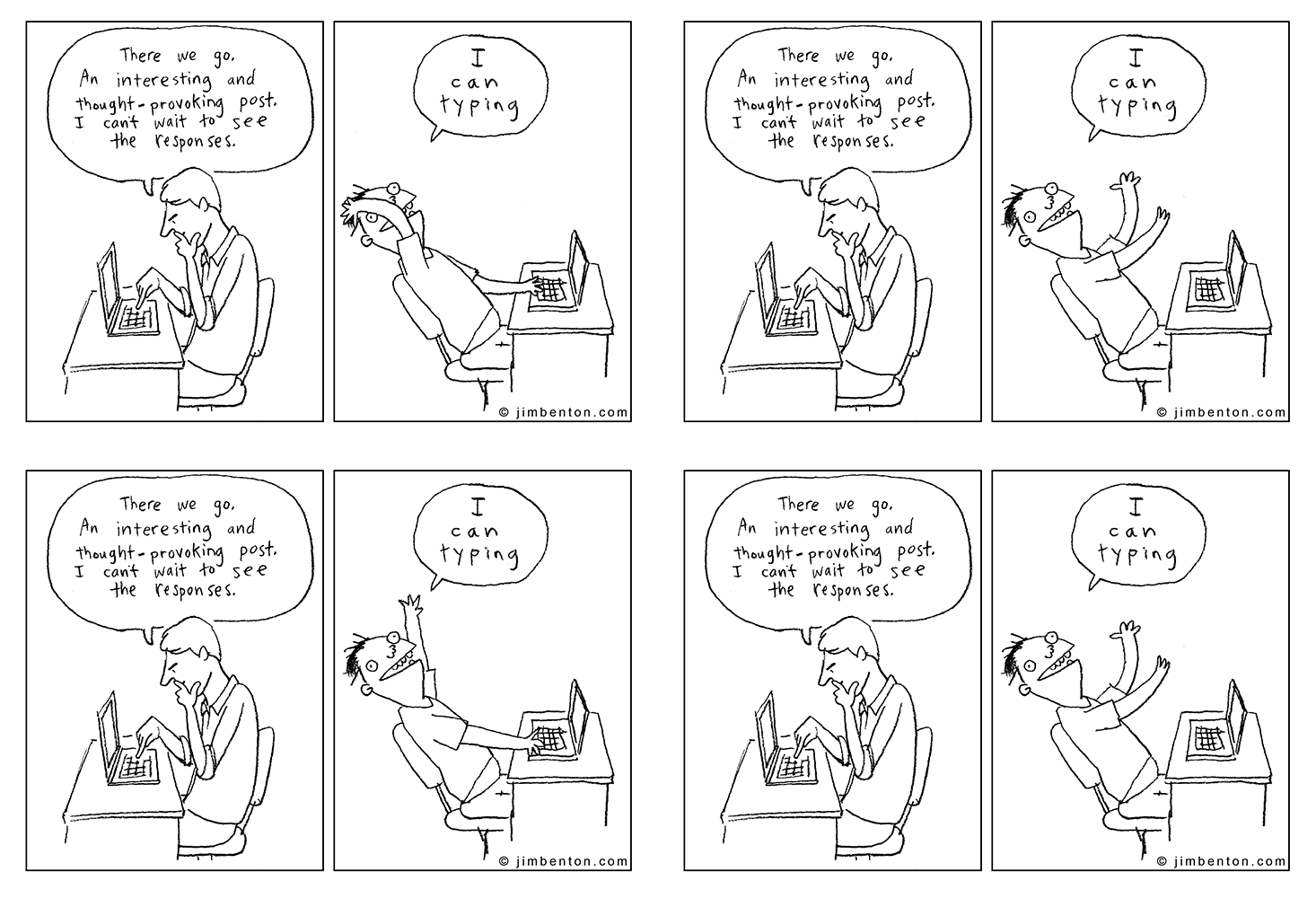
The only difference for me is that I begin by dreading the responses.
Comic by Jim Benton.
 Thanks to a Fireballing, I rediscovered this essay by Rod Hilton on a suggested viewing order for the Star Wars films which, he says, makes for a much better story, retains most of the big twists and reveals, and concentrates more strongly on the more compelling narrative: the Luke story over the Anakin story — the Anakin story winds up serving as flashback-background material for what really matters.
What you wind up with is this:
1) A New Hope (IV)
2) The Empire Strikes Back (V)
3) Attack of the Clones (II)
4) Revenge of the Sith (III)
5) Return of the Jedi (VI)
Hilton’s order, which he calls “Machete Order,” makes one big sacrifice, which is the omission of Episode 1, The Phantom Menace.
Says Hilton:
. . . this creates a lot of tension after the cliffhanger ending of Episode V. It also uses the original trilogy as a framing device for the prequel trilogy. Vader drops this huge bomb that he’s Luke’s father, then we spend two movies proving he’s telling the truth, then we see how it gets resolved. The Star Wars watching experience gets to start with the film that does the best job of establishing the Star Wars universe, Episode IV, and it ends with the most satisfying ending, Episode VI. It also starts the series off with the two strongest films, and allows you to never have to either start or end your viewing experience with a shitty movie. Two films of Luke’s story, two films of Anakin’s story, then a single film that intertwines and ends both stories.
I am intrigued by this, but I have one major problem with it. While Hilton obviously has no love for Episode I, to me, the real problem in terms of movie quality is Episode II.
Let me be a little more clear about this. The Phantom Menace is not a great film, but Attack of the Clones is, perhaps, the worst movie ever made. And it’s really for one reason: The Anakin-Padme scenes.
Don’t you remember the one time you saw it (I presume it was only once because it was so awful)? The insipid, schmaltzy, drippy dialogue between Anakin and Padme in their atrociously-written “love” scenes? The mush-mouthed, one-dimensional performance of Hayden Christensen, who should never have been allowed near a piece of text? The deadening of Natalie Portman’s acting skills through terrible writing and absent direction?
It was almost too much to bear. My friends and I seeing it in the theater were cringing, silently at first, and over the course of the film vocally, contorting our faces as we endured this cinematic offense. Only because it was Star Wars did we power through, for if it were a standalone movie it would be too much to stand, and we’d have left a half-hour in.
Episode I has a mediocre child actor and some borderline-bigoted portrayals of CGI aliens, but it’s not the wholesale disaster that Lucas inflicts on us in Episode II.
But Hilton is no doubt correct in his essay, though, that Episode II is too crucial in terms of constructing the whole reason behind Vader/Anakin’s fall to the Dark Side, and Episode I really isn’t at all.
So if we’re really talking about a “Machete Order,” maybe some enterprising remixer could take Episode II, and heavily edit it to sufficiently tell the story of Anakin and Padme’s relationship and its importance to the arc, while making it more merciful on the viewer. Maybe just leave in longing looks or something, and skip the dialogue altogether.
Never the less, I think I may give this order a shot. I’m not even that big of a Star Wars fan (I’m a would-be citizen of the United Federation of Planets), as I think it rests on too many tropes of prophecies and “chosen ones” and hyperviolence that interest me very little in terms of fiction. But it’s still a fun trip, and if this makes it a better trip, then it’s worth checking out.
The opening track from my 2004 record Paul is Making Me Nervous. It’ll slay the crowd and impress your mom.
One of Toby’s favorite songs for bedtime used to be Toad the Wet Sprocket’s “Walk on the Ocean,” and like all bedtime songs he favors, it had to be sung every night for months.
Current favorites, incidentally, include “She’s an Angel” by They Might Be Giants, “Somewhere That’s Green” from Little Shop of Horrors (which I’ve been singing to him since he was a baby), and The Police’s “Walking in Your Footsteps,” because, of course, it’s about dinosaurs.
Anyway, I remembered this video I made back in July when Toby was about two-and-a-half, singing from the comfort of his then-new big-boy bed. Nice for a peaceful Sunday.
I’ve been looking for ways to express my feelings about online interactions of late, and rather than articulating them successfully, I’ve been having something of a public meltdown.
I am therefore grateful to whoever the hell it is behind the Twitter persona @pourmecoffee for his recent post, which included this:
I instantly and irreversibly block based on @replies I find annoying. Yes, it’s selfish. Yes, it’s about me. That’s the whole point. It’s not that I care about your brilliant reply or who reads my posts. You could very well be “right.” I just don’t care. I don’t want to hear it. I have no patience for conflict junkies or hyper-argumentative people polluting my stream. I don’t want to debate you. I don’t want to trade clever put-downs. I don’t want to go back and forth trying to get the last word. I don’t like to be trolled, nitpicked, or insulted. This is a personal account. You’re not paying for it. Shocking: I don’t like to get hassled, and will block to avoid it. I’m not the guy to satisfy your need for epic battles, flame wars, or online validation. There are plenty of people itching for a fight, just not me. Go be annoying, rude, combative or your positive spin on those things somewhere else. I will ruthlessly curate my online experience to selfishly satisfy my own sensibilities and make it fun for me, period.
I aspire to this.
 It can’t be helped. When you have a household with a 3-year-old obsessed with dinosaurs and a daddy with a weird sense of humor and desperate need for validation, silly songs emerge.
A late addition to Toby’s Netflix repertoire is Walking with Monsters, a Branagh-narrated spinoff of Walking with Dinosaurs that features pre-dinosaur creatures in a faux-documentary.
As noted in an earlier post, the original show led to my little ditty about Eustreptospondylus. Well, now we have a protodinosaurian rhyme. It’s a rap of sorts for the Euparkeria (pronounced “you-par-care-ee-uh”), a small-ish reptile with particularly-shaped hip bones that allowed it to go bipedal with great agility when necessary, and served as an evolutionary foundation for the dinosaurs. Or so says Kenneth Branagh.
The rhyme is done in a style reminiscent of “Rapper’s Delight,” with a meter similar to Strong Bad’s “fhqwhgads.”
I bring you “Euparkeria.”
Eu! Par! Ker-i-a!
He’s gonna catch a dragonfly
Eu! Par! Ker-i-a
YOU are my fav-o-rite guy!
(Come on now)
Eu! Par! Ker-i-a
He dunna need to go on all fours
Eu! Par! Ker-i-a
Ancestor to the dinosaurs!
Toby was loving the first two lines, and was hopping up and down on the couch this morning reciting it. The addition of the second two lines, however, seemed to greatly upset him at first, for some reason inducing a toddler spinal-fluctuation tantrum. But he’s come around on it.
From Miriam Mogilevsky, who blogs here at Brute Reason, but posted this elsewhere for no reason:
. . . our society pushes certain types of people down, and then mandates that we all “love ourselves”—and if we fail to do so it is OUR fault. I do think there are things anyone can do to cultivate self-love even when it has been taken away from them, but with every injunction to “love yourself” comes an implicit blame if you do not.
Try to be okay with yourself. Try not to listen when the world tells you that who you are is wrong. Loving yourself and your body can wait, and besides, it’s not necessary for a happy and healthy life.
Damn right. Not to say that I’m in any way an example of someone who’s healthy, but I do love my kids and wife, and they love me, and you know, loving myself, well, let’s not get out of hand.
Whenever I’m told I need to love myself, I feel like I’m being asked to lie, to pretend to feel something I don’t. I spent most of my adolescence being informed continuously that I was lowest of the low and unworthy of even human decency, let alone love, and I learned to believe it. Messages about what it is a man is supposed to be in the media were not at all helpful. And other things happened, too. So I really don’t feel like “loving myself” is a fair expectation, not in any immediate sense.
I don’t at all object to affirmations in a therapeutic context, as one can alter one’s perspective simply by rote (very long and repetitious and tedious rote), but to beat on this canard that “you can’t love someone until you love yourself” is destructive and often a catch-22. Some kind of validation has to start the process.
I’m going to start with learning to accept myself, which is big enough of a lift as it is. Trust me. Love, well my kids and wife need that from me more than I do, and they can have it. All of it.
Good morning. Play this loud.
From my 2004 record Paul is Making Me Nervous.
 pav dot quest