While I’m very much interested in Shakespeare’s life, I’m more interested in my own. What I extrapolate from The Winter’s Tale is that if Leontes deserves a break, so do I. There came a time in my life when I needed to be forgiven. I wasn’t. If I must take my consolation from a play rather than from any flesh and blood Hermione, that’s not quite so bleak as it sounds. Yes, I would have preferred real forgiveness to the literary kind, but I find it no small consolation that at the end of his life the world’s supreme imaginative writer returns again and again to a basic home truth: we must forgive each other. For me, reading Shakespeare is like going to church, except that in place of a God I could never and wouldn’t want to believe in, I “commune,” so to speak, with a mind that seems to comprehend all others and enforces no doctrinal obedience. This community of believers embraces anyone who has ever seen, heard, or read a word of Shakespeare’s and been moved to wonder and reflection. That’s what I call a catholic church.
Tag: culture
-
Reading Shakespeare is like going to church
-
I Need to Listen a Little More Slowly
Stephen Fry, with a hat tip to Kylie Sturgess:
A concerto is an argument between an individual and the state. Between an individual and society. It is an individual voice crying out and trying to make a statement of some kind. And it’s often drowned out by the orchestra, and it fights back. And the orchestra fights back. And it fights back. And the dynamic of listening to that is like nothing on Earth.
-
Formed by Boredom
This worries me a little (by Toby Litt in Granta):
A couple of years ago, I spent three months playing World of Warcraft – partly as research for a short story I was writing, mostly because I became addicted to it. This convinced me of one thing: If the computer games which exist now had existed back in 1979 I would not have read any books, I think; I would not have seen writing as an adequate entertainment; I would not have seen going outdoors as sufficiently interesting to bother with.
Similarly, I find it difficult to understand why any eleven-year-old of today would be sufficiently bored to turn inward for entertainment.
This raises the question as to how future writers will come about, without ‘silence, exile and cunning’ – without the need for these things?
I was formed, as a writer, by the boredom of the place in which I lived.
Now, I did have video games when I was eleven (not anything of the scale or complexity of WoW, but I had the NES and the Segal Genesis), and I think they are a big reason (second only to cable TV) as to why I almost never read books at that age, despite being “bookish” in all other respects. With rare exceptions, I allowed the television screen to use up almost every single waking minute of my life. I can’t tell you how much I regret that.
Eventually, I got bored. In my boredom, I learned to play — just barely — some guitar, and wrote songs. Or wrote in my journal. As a young adult, particularly when I was a working actor without television available to me, I got really bored, and dove head first into my songwriting, and other reading and writing as well, for a good stretch of about five years.
But in the thick of the social web today, along with the rigor of parenthood, I am once again rarely bored. I loathe television now, even to the point where even high-quality programming makes me impatient and anxious for the time I lose to viewing it. But my iPad and Mac and iPhone ensure that I never need be without distraction once the kid is asleep.
A happy difference now from my days of TV-cured boredom is that I spend a huge amount of time on my devices reading, far more than I did as a child or teenager. I am not delving into genuine books as much as I would like (and not nearly as much as I did when I was essentially bereft of television and Internet access), but my iPad serves primarily as a reader for long- and medium-form written content. I almost never visit YouTube, I play almost no games, etc.
But that’s me, a nerd who never fully embraced his nerddom in his teens, and is now trying to intellectually and culturally catch up. To today’s eleven-year-olds, will such an endeavor even occur to them? I’d like to think so. I’d like to think, at least, that they’ll do better than me. On a hopeful note, my two-year-old son Toby, who, although he does love his episodes of Dinosaur Train, absolutely loves books and being read to. I will do all I can to keep him loving books. He’ll be a better man for it.
-
The Veracity and the Vicissitude of Mike Daisey
 Listening tonight to the nearly-unbearable “Retraction” edition of “This American Life” in which Mike Daisey is taken to task for his fabrication of details about his experiences in China, I kept waiting for Daisey to more effectively counter the assertion by Ira Glass that people who come to see a monologue expect that every word of it is true.
Perhaps it’s because Glass and the myriad bloggers and reporters feasting on this story are themselves journalists, and therefore can’t help but expect something like this to be akin to what they do, a retelling of actual events. And perhaps it’s because my roots are in theatre that I feel like Glass is wrong; one may not even think about it consciously while watching a show, but I feel that people on the whole do understand that a show is a show. I know that when I saw Daisey perform his excellent How Theatre Failed America in DC a few years ago, I certainly had no illusions that he was giving a 100% factual account of his life in theatre. Of course he was going to embellish, exaggerate, and invent. Why? Because he was spinning a tale, based on facts but not relying on them, that told a larger truth.I understand that at least as far as “This American Life” and, perhaps even more damning, his op-ed in the New York Times are concerned, it’s the packaging of his story that matters. It does indeed sound as though Daisey offered his play as an entirely factual retelling and therefore worthy of being used as such on the show (and that his manufactured experiences could be written as though they were actual reportage for his New York Times piece). There’s no excusing the presentation of fiction as fact to news outlets.
But I have to wonder at “This American Life” for even wishing to do so with Daisey’s play. If they wanted to use his piece as a springboard, why not simply excerpt some pieces of a performance, make clear that what we’re hearing is a story told by an actor in a play, and then delve deeper into the very real, no less serious issue at hand? Why even decide to hand essentially an entire episode over to what they know is a piece of theatre? Glass says not killing the show after being thwarted in their attempts to contact Daisey’s translator was their big mistake. I think their big mistake was in thinking that a play might possibly be, not just the inspiration, but the substance of one of their reports. I find it hard to believe, but I am forced to believe, that Glass and company are as naive as he claims they are when it comes to credulousness about the veracity of performance art.
I don’t know what Mike Daisey was thinking. He’s such a brilliant writer and performer, and I think it would be a genuine, substantive loss to the culture if we were to lose what he does because of this — particularly since his larger motive was so crucial, so real. I can only presume that the idea of getting his show on “This American Life” and of getting to be treated with a kind of reverence by the media became con-fused with that larger motive. He is an actor, after all, and we are nothing if not attention whores of the worst kind. (Hey! Go download my music!!!!) I wish so badly that he had handled this all so differently. All he had to say to Glass, to the media, to his audience, in any subtle form he wished, that his play is just that, a play, but that it is based on many true events and reports. Done.
I also wish that when Ira Glass pressed him as to whether it was acceptable for his play to be in part constructed of fictions that he had said, proudly, that the art of storytelling has a different goal than journalism, and that his job is to get his audience to think and to feel something. Daisey does that extremely well, and the things he wants us to care about remain worth caring about.
Side note: I am more than a little sickened by many of the tech bloggers and journalists whose work I usually think extremely highly of, but are now dancing on Daisey’s reputation’s grave, almost delighted that Daisey is facing this new firestorm. This seems to me to be borne out of nothing other than their own desire to not have to feel anything about the source of the gadgets off of which they base their careers. Now they’re off the hook, so they believe, and they have someone to put in the stockades for his heresy. It’s deeply disappointing.
-
Suggesting People into Loving Their Servitude
Within the next generation I believe that the world’s rulers will discover that infant conditioning and narco-hypnosis are more efficient, as instruments of government, than clubs and prisons, and that the lust for power can be just as completely satisfied by suggesting people into loving their servitude as by flogging and kicking them into obedience. In other words, I feel that the nightmare of Nineteen Eighty-Four is destined to modulate into the nightmare of a world having more resemblance to that which I imagined in Brave New World. The change will be brought about as a result of a felt need for increased efficiency. Meanwhile, of course, there may be a large scale biological and atomic war — in which case we shall have nightmares of other and scarcely imaginable kinds.
Thank you once again for the book.
— Letter from Aldous Huxley to George Orwell, found via Teleread.
-
Reading is Self-Mastery
D.G. Myers positions reading not as an escape but as a challenge to ourselves:
To read an author is to read someone different from ourselves. Reading is not a means of self-affirmation, but of self-denial. Any book that is any good challenges its readers: This is so, isn’t it? Did you know this? Have you considered that? [ … ]
Hence reading is self-mastery, because the self (and its affirmations) are held in check while the author (and his structures of thought) are fully attended to. True diversity in literature would be to read authors in circumstances as different from our own as possible, because we might then imagine ourselves as different than we are — not the creature of circumstances, but their master. Reading is fundamental, all right: to a person’s ethical development.
You can say the same about most great art, and it certainly need not be limited to fiction, though I grant that a fictional narrative will likely place the reader closer to the thoughts of the subject at hand. But consider great theatre and film, even music or dance in the more abstract sense, in how they can shake us from our comfort zones, force us to empathize with characters to whom we would normally never relate, those of different times, situations, and motivations.
I’ve cited it before, but it bears repeating here. I am once again reminded of the panhandler interviewed in Al Pacino’s documentary, Looking for Richard.
We should introduce Shakespeare into the academics. You know why? Because then the kids would have feelings. We have no feelings. That’s why it’s easy for us to shoot each other. We don’t feel for each other, but if we were taught to feel, we wouldn’t be so violent. Does Shakespeare help us? He did more than help us. He instructed us… . If we think words are things and have no feelings in words then we say things to each other that mean nothing. But if we felt what we said, we’d say less and mean more!
So say we all.
-
Then Vonnegut Asked Caro, “Are We in the Same Trade?”
I’ve not yet read any of Robert Caro’s enormous Lyndon Johnson biographical series, even as he readies to release the latest volume that takes the subject up to his ascension to the presidency. I intend to read them, and the political world has a minor buzz to it because of this imminent release.
In another world, I was alerted to the fact that well before he tackled Johnson all those decades ago, Caro had written a biography of Robert Moses, The Power Broker. I found this out thanks to John Siracusa’s use of this book as an example a biography against which all others could be judged (in the context of lambasting the Steve Jobs biography on his podcast Hypercritical).
It was only serendipitous, then, that I stumbled upon this gem, a literary magazine piece from 1999 in which Caro is interviewed by perhaps my favorite novelist, the late Kurt Vonnegut. It’s wonderful, and I thought I’d at least share a snippet to give you a taste of its overall flow:
VONNEGUT
Let me ask you a question, Bob. I was on a panel with Joe Heller down in Florida. We were talking about the war mostly because that’s what we wanted to talk about, but I asked him at one point if he was disappointed about what the country has become. Because I am deeply disappointed. I was a prisoner of war with the Brits and the French and listened to all their plans for after the war, wanting justice and distribution of power in the world and that sort of thing, and Heller said that he was not disappointed-that he was unsurprised that the nation had turned out this way. Are you disappointed?
CARO
I guess, in a way, I am. I think with all our riches and wealth and the fact that we don’t have an enemy now who can threaten us, we ought to be doing a lot more now with the dispossessed of the world and the Blacks and Hispanics in our own country. I don’t think we’re doing very much compared with what we could do.
VONNEGUT
Well, what about your basic trade of journalism…What are you, sixty, now?
CARO
Sixty-one.
VONNEGUT
All right, so in the past thirty years, how has journalism done?
CARO
Yeah, I’m very disappointed in that. Aren’t you?
The interview opens with Vonnegut, a novelist, asking Caro, a biographer, whether the two of them are “in the same trade.” Fantastic. Read the whole thing.
-
Constructive versus Destructive Atheist Activism
Chris Stedman gives voice to a concern I’ve had of late (and unfortunately does so in the Huffington Post, but we’ll let that go):
I maintain significant disagreement with many religious beliefs, but I do not wish to be associated with narrow-minded, dehumanizing generalizations about religious people. I am disappointed that such positions represent atheist activism not only to the majority of our society, but to many of my fellow atheist activists as well.
I have been guilty of this myself, and like Stedman, I have no qualms about actively questioning all forms of irrational, baseless belief, but I also have in recent years come to feel less adamant about casting all forms of spiritual seeking into the same ditch as fundamentalism.
Stedman’s prime example of the ugly confusion about what it is nonbelievers ought to be doing with their energies and activism is the embarrassing and grossly wrongheaded campaign by American Atheists to remove the “World Trade Center Cross” from the 9/11 Museum, something I also noted as a wrongheaded move because it focused to stopping religion willy-nilly, rather than acknowledging the object’s place in history. I wrote then:
I don’t have to like it. The World Trade Center cross was there [in the aftermath of the attack], and the people of New York divested it with meaning, and thus it became a character in the story of the 9/11 attacks. Its placement in the museum is not an endorsement of Christianity, it’s a page in that story. Whether I like that part of the story or not.
Suing to have it removed was vindictive rather than productive or consciousness-raising. Perhaps that’s the key difference: what can we do that is improves people’s awareness and sensitivities versus waging merely a zero-sum game of conflict?
Recently, Andrew Sullivan did a video post explaining his approach to prayer, and it was about the least objectionable explanation of what prayer is or can be that I’ve ever heard. I obviously don’t subscribe to his position or believe there is any mystical force listening to one’s prayer, but if Sullivan’s version of belief and prayer were the dominant one, there’d be little need for the anti-religious movement that Stedman sites.
Food for thought as we approach December 31, at this socially-constructed-yet-somehow-poignant time of reflection.
-
Unnecessary Nostalgia for the Idiot Box
Almost a year ago, the New Yorker published a piece by Adam Gropnik digesting various tomes about what the Internet was doing to us as a culture, ranging from the folks who saw it as the coming of paradise to the coming of the end times. One recurring theme with those who saw the Internet as a net negative, and indeed with historical treatises that feared the emergence of any new technology (polemics against the radio, the printing press, etc.), was how whatever technology that immediately preceded the one in question was always the benign, rightful one to which we owed our allegiance.
And what’s shocking to me about that is how some in Gropnik’s survey of the literature have bestowed this current honor on the television set. He writes, with an implied shake of the head:
Now television is the harmless little fireplace over in the corner, where the family gathers to watch “Entourage.” TV isn’t just docile; it’s positively benevolent. This makes you think that what made television so evil back when it was evil was not its essence but its omnipresence. Once it is not everything, it can be merely something. The real demon in the machine is the tirelessness of the user.
I say that this is shocking because not only is this view somewhat risible (as indeed Gropnik find it), but that it ignores the enormous sway television still has. The implication of this neo-Luddite view is that these days television is the wholesome-yet-forgotten technology versus the Internet, which is the wicked-and-ever-present one. Yes, our attentions are more fragmented, but the TV has hardly been removed from its central location in family life. Indeed, if anything, TV is as fragmented as other “screens,” what with the avalanche of channel and on-demand selections and the fact that most families have several sets with very few watching the same set at the same time.
And this sway the TV retains is also, I think, far worse than whatever defects are engendered by the Internet. Think first of the poor quality of almost all televised content, think of the low common denominators to which it must aspire to reach maximum potential audience sizes. Then, remember that TV is passive. It is something one consumes, something that washes over the viewer, while the computer, the Internet, at least has the capability of being participatory. It isn’t always, and maybe it isn’t usually, but the potential is there. With television, one can only watch.
So earlier tirades about how TV was ruining what was good about radio and how radio was ruining what was good about books, etc., at least had a grain of truth to them, whether or not they were overblown. But today, citing the television as the superior and more culturally benign medium over the Internet is absurd. The sooner what we now know as TV is killed by the Web or Apple or whomever, the better.
“Once it is not everything, it can be merely something,” Gropnik writes, but so far, TV is still close enough to “everything” that it need not be mourned.
-
You’re So Smart! No I’m Not!
I tell my almost-two-year-old son Toby how smart he is all the time. It was said to me over and over when I was a kid.
Decades later, I know in hindsight that I believed my “smartness” to be innate and unrelated to effort or discipline. I therefore, in turn, also believed that when I felt challenged, that it was because I lacked a sufficient amount of “smartness” — that I was inherently flawed and unable to achieve a goal, rather than because of a lack of sufficient effort. I won’t go into it here, but I’ll just say that it’s perhaps the biggest psychological challenge I now face in the wake of all the other traumas with which I’ve had to cope of late. It’s a discovery I’ve only recently made, and it’s of enormous significance for me.
And then, as though the folks at Bloomberg News have been listening in on my therapy sessions, my too-smart-for-whatever-room-he’s-in pal Skylar linked to this piece in Businessweek:
People with above-average aptitudes — the ones we recognize as being especially clever, creative, insightful, or otherwise accomplished — often judge their abilities not only more harshly, but fundamentally differently, than others do (particularly in Western cultures). Gifted children grow up to be more vulnerable, and less confident, even when they should be the most confident people in the room.
The piece then cites a study on how well-meaning, shorthanded evaluation of children effects their performance.
Dweck and Mueller found that children who were praised for their “smartness” did roughly 25% worse on the final set of problems compared to the first. They were more likely to blame their poor performance on the difficult problems to a lack of ability, and consequently they enjoyed working on the problems less and gave up on them sooner.
Children praised for the effort, on the other hand, performed roughly 25% better on the final set of problems compared to the first. They blamed their difficulty on not having tried hard enough, persisted longer on the final set of problems, and enjoyed the experience more.
The conclusion, with emphasis from the original:
The kind of feedback we get from parents and teachers as young children has a major impact on the implicit beliefs we develop about our abilities — including whether we see them as innate and unchangeable, or as capable of developing through effort and practice.
Let me tell you from first hand experience, this mountain feels utterly unscalable. Only a lot of time and, well, effort, will tell whether I can traverse it. I’m somewhat gladdened, perhaps a bit validated at least, to see it acknowledged in this form.
-
Know Thine Enemy, Or Look Like a Damned Idiot
 Might as well be Hitler.
Few things are as frustrating to do-gooder liberals like myself as when other do-gooder liberals go off the deep end. Whatever the cause, however so worthy it might be, crossing the line from passionate to goofy is so easy, and happens to often. Then, of course, the cause itself loses credibility along with the offending do-gooder. You know how it goes; public support starts to build around something like, say, the environment, and then some nutty hippie group pulls some embarrassing stunt, making themselves look ridiculous and hurting the cause.
Two such items have come up of late. A few weeks ago, I was spooked into thinking that the Occupy movement would soon be derailed thanks to Occupy Atlanta’s treatment of civil rights hero Rep. John Lewis (yes, I hate that the video comes from a conservative “gotcha” outlet). If you missed it, he wanted to address the assembly, but one dissenter in the crowd (who acknowledged Lewis’s invaluable contribution to society at least) piped up and insisted that Lewis not get to address the crowd because, as others in the crowd insisted, he was “no better than anyone else.” A long, maddening people’s-mic debate began, and it served to exemplify the worst stereotypes of liberals — over-thinking, over-talking, disrespectful, and stultifyingly beholden to arcane bureaucracy for the sake of bureaucracy.
And sorry, Occupiers; I love what you’re making happen, but some people are better than others, and John Lewis most certainly is one of them. Rep. Lewis, who appeared to do his best to honor the procedures of the group, eventually left, I imagine rather confounded.
The latest example that has attracted my forehead to the surface of a desk at a high velocity comes from a common offender, PETA. I support the overarching goal of PETA, to, well, treat animals ethically. Already prone to knee-jerk reactions, PETA has chosen perhaps the most ridiculous target of its entire existence: Super Mario.
PETA … believes Mario takes a “pro fur” stance” because he “wears the skin of a raccoon dog to give him special powers” in the new handheld game released Nov. 13.
On Monday, PETA illustrated its disgust with Nintendo in an online campaign called “Mario Kills Tanooki.” The page includes a side-scrolling Super Mario-style game called “Super Tanooki Skin 2D,” where you play an angry, skinless tanuki that must chase a bloody raccoon-pelt-wearing-Mario across a 16-bit world and try to reclaim its fur.
Yeah. That’s the message of Super Mario: Skin helpless mammals and take their strength. That’s certainly the lesson I learned as a kid when Super Mario Bros. 3 came out and introduced the raccoon suit. In fact, my brother and I would walk outside the house, bleary-eyed from hours of gaming, and seek out stray dogs and cats, force the removal of their hides (ignoring their yelps of pain, of course), and donning them in order to imbue ourselves with their magical powers.
There are real battles to be fought on behalf of animals. There is a real struggle for equality in our society where those who are not already powerful have no voice. Those causes are damaged when passion and ideology totally trumps reason, and then beats it to a pulp.
(Hat tip to Skepticality’s Derek Colanduno for the PETA link.)
-
Superiority over the Superior
David Brooks, from his fixed position as Moral Center of the Universe, bemoans our collective feeling of superiority over those who failed to stop the horror of the Penn State scandal.
Commentators ruthlessly vilify all involved from the island of their own innocence. Everyone gets to proudly ask: “How could they have let this happen?”
The proper question is: How can we ourselves overcome our natural tendency to evade and self-deceive. That was the proper question after Abu Ghraib, Madoff, the Wall Street follies and a thousand other scandals. But it’s a question this society has a hard time asking because the most seductive evasion is the one that leads us to deny the underside of our own nature.
Wrong. There are two proper questions. One is indeed the question Brooks asks about how we as a species can ignore the horrors all around us.
But I’d say that “How could they have let this happen?” is itself a pretty god damned good question too, and I hope people are asking the ever-loving shit out of it right now.
This is something that drives me nuts about Brooks (besides his expertise at the Douthat Twist), who I think is a well-meaning, thoughtful guy; he never wants to attack a specific problem or person, as he’s obsessed with more global or systemic failings, or really, “sin.” That’s fine, we are too short-sighted as a culture and need the wide view brought to bear far more often. But with Brooks, it’s so often either/or; ‘let’s not vilify wrongdoer X, because the “real” problem is everyone and everything.’
Yes, let’s tackle the overall illness holistically, fine, but let’s also make sure we’re not forgetting to cut out the actual tumors.
-
Grieving an Ethos: Thoughts on the Loss of Steve Jobs
Most of the people I work with are, naturally, having very strong feelings about the death of Steve Jobs. But not all, and that’s fine. My wife is also not what I would call crushed by his passing, but she is extremely sympathetic and supportive; she understands how I revered the man and what he built. But I do tend to get hung up on the contrarians: why should I mourn — why should I feel so deeply sad — over this super-rich guy who I’ve never met?
It is a deep sadness. There’s no getting around it; my heart has been very heavy, as though its soaked in thick liquid. The idea of his absence is creating a physiological distortion that my mind can’t entirely process.
But I am also that guy who tends to roll his eyes at the gushing over dead celebrities. I didn’t understand the writhing over Princess Diana, she really did seem to me to be just a lucky rich person, who was probably very nice, and died tragically. But that happens all the time to good people who don’t happen to be really rich. I’m even worse with public fingers who at least in part bring it on themselves through excessively damaging choices. I am the eye-roller over public gnashing of teeth over the expiration over the otherwise super-fortunate.
My feelings about the loss of Steve Jobs is different, though, but it took me some thinking to figure out how.
Steve Jobs was not tapped by fortune, he was not swept into history by forces outside his control. He built everything he had bit by bit. He suffered for his sins, took his punishments, and climbed back out of the ditch to become even stronger than he or anyone else could have imagined. He did it with his own talents, his own mine, his own nearly-insane work ethic. His own love of the work.
And what he built is, of course, more than a company. Just like the Beatles did more than just record some albums. Like the Beatles, Steve Jobs affected the culture. He crafted an ethos, he championed a way of thinking, he embodied a particular spirit. Not all aspects of what he created were of his devising, and his successes were not due to him exclusively.
But he is responsible for putting this ethos into practice so that it served as the framework for Apple’s products, for the company itself, and for all those who sought to learn and grow by that ethos. It is not so much the stuff he made for all of us to buy. It is the culture he spawned, something that now lives on in countless thousands of people who have opened their minds and hearts to it, this philosophy, this ethic, this credo.
I grieve for Steve Jobs much like I grieved for Carl Sagan, like many who grieved for John Lennon, before I was old enough to know who he was. These are people who not only added to the catalogue of human-borne discoveries, ideas, and products, but they changed — and in their way created — the best aspects of what we consider human culture.
I did not lose a friend or family member, but my species lost an important source for its culture. If my tears fall, they fall for the great hole left in our civilization by the loss of Steve Jobs. It’s hard to believe he could die at all. But he’s gone, and all we can do is work to fill that chasm with our own emanations, our own representations of that ethos.
It won’t be the same, but it might be enough. But to fill that hole, we’ll have to be crazy enough to think we can.
-
“If They Like Printed Books, They Should Be Buying the Damn Things”
 Richard Nash validates my take on what I call the “But I Love the Smell of Books” argument against the digitization of the traditional codex, focusing on the fact that if books are so important as physical artifacts, they are not being treated as such by the industry or even consumers:
If they like printed books, they should be buying the damn things instead of whining about other people’s preferred mode of reading. So I’m tremendously optimistic about the future of the book as an object. I think the worst years of the book as an object have been the last 50 years.
… Because when the book’s primary purpose was not to be an object, but rather to be a mass-produced item for sale in big-box retail, then there’s going to be downward pressure on costs. And so what we have witnessed over the last 50 years is the progressive shittification of the book as an object—a process that is not external to publishing as it was practiced over the last 100 years, but has in fact been at its fore.
Nash argues that those who truly value the physical book will continue to purchase it, that this product will always be available as long as demand exists (which he presumes it will). The real problem for publishing, he says, is one I’ve seen made in a similar way before at Booksquare, there is too much emphasis on what a book costs in terms of dollars rather than on the quality of the content or the experience:
What does a person do when they want something to read? One of the big mistakes that often gets made in publishing is we focus a lot on price. We focus on how much a book costs and we decide whether it’s worth it or not. Now we’ve got a lot more books that are absolutely impoverished. The reality is that people’s decision-making process has a lot more to do with time than with money. It’s 15 hours in the inside of your head. Books are so cheap compared to the hours of entertainment they provide. The problem is, do they provide entertainment? Is it in fact a book you want to read? If after four hours you hate it, what most people say is “I can’t believe I spent fifteen dollars on this.” But what they really mean is “I can’t believe I just wasted four hours of my life on this.”
This is particularly salient for me. I’m not a terribly fast reader — I’m told I “subvocalize” which condemns me to the literary slow lane — so the quality of time spend with a given text is more important to me than almost any other aspect of a book. Yes, I think on the whole 20 to 30 dollars is too much to spend on most books, but, for example, the quality of the experience of reading Neal Stephenson’s Anathem was worth far more.
-
Save Science by Not Talking about Science, Ctd.
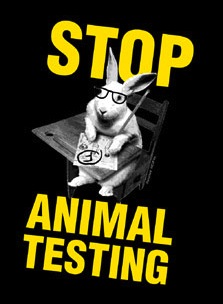 Side note: My dad actually bought me this shirt. I love it, and my wife hates it when I wear it. She just thinks it makes me look stupid. I don’t think she cares about the rabbit.
John Timmer at Ars Technica places a plague o’ both your houses when it comes to the convenient rejection of scientific fact. And he’s right.
For many in the US, expertise has taken on a negative cultural value; experts are part of an elite that thinks it knows better than the average citizen. (This is accurate, for what it’s worth.) Very few object to that sort of expertise when it comes time to, say, put the space shuttle into orbit, but expertise can become a problem when the experts have reached a consensus that runs against cultural values.
And, for many in our society, scientific expertise has done just that. Abstinence-only sex education has been largely ineffective. Carbon emissions are creating a risk of climate change. Humanity originated via an evolutionary process. All of these findings have threatened various aspects of people’s cultural identity. By rejecting both the science and the expertise behind it, candidates can essentially send a signal that says, “I’m one of you, and I’m with you where it counts.”
This is not some purely partisan phenomenon. On other issues, rejection of scientific information tends to be associated with the political left—the need for animal research and the safety of genetically modified foods spring to mind. These positions, however, are anything but mainstream within the Democratic Party, so candidates have not felt compelled to pander to (or even discuss) them, in most cases. That’s created an awkward asymmetry, one where a single party has a monopoly on public rejection of scientific information and certain kinds expertise.
It’s not really symmetrical; there can be little doubt that the right’s repudiation of reality is far worse than that of the left’s. That said, most of the false panic about vaccinations causing autism, for example, is fomented on the left (and sometimes even aided by left-leaning publications like the Huffington Post). And when nonbelievers who tend toward the Democratic Party make their views known, they often accused not of being too left-wing, but too right-wing, as though their confidence in the nonexistence of a magic super-being (which is based on science, fact, and reality) is somehow equivalent to the right’s zealous insistence of the opposite (which is not); it goes against the more mainstream left wing value of tolerance and diversity for their own sakes.
But to Timmer’s point, a lot of this organized willful ignorance is abetted by a general American distrust of experts and intelligence. It seems to threaten people when it’s not fully graspable immediately. (Note the different attitudes to expertise in athletics or business, which I think doesn’t seem as arcane to the general public.) Which is why, politically, I think these arguments for now need to be framed not in terms of which academics agree with what proposition, but what is simply true, like gravity makes things come down, like fire burns and ice is cold. It’s probably our only shot.


 pav dot quest