We can … know with certainty that the Christian God does not exist as standardly defined: a being who is omniscient, omnipotent, and wholly benevolent. The proof lies in the world, which is full of extraordinary suffering. If someone claims to have a sensus divinitatis that picks up a Christian God, they are deluded. It may be added that genuine belief in such a God, however rare, is profoundly immoral: it shows contempt for the reality of human suffering, or indeed any intense suffering.
Tag: religion
-
Contempt for the reality of human suffering
-
In Which I Read the Sam Harris-Bruce Schneier Debate So You Don’t Have To
Long story short: Sam Harris said that we should specifically profile Muslims at airports, not grandmas in wheelchairs and 4-year-old girls, because if someone’s going to try to crash a plane in 2012, it’s almost certainly going to be a radicalized Muslim.
Liberals went insane, calling Harris a racist and other terrible things, atheists disowned him, and I think somewhere Gandhi cried. Harris said, okay, then let me debate it with a security expert. He nabbed security bigwig Bruce Schneier, and they had at it on Harris’s blog.
I begin this as a huge fan of Sam Harris. He has helped me find so much clarity on a enormous range of issues, that he’s something of an intellectual role model for me. Even if I disagree with him, the path he takes to his positions I find extremely admirable.
On this question in particular, I had a lot of cognitive dissonance. My cold, atheist brain said, “Oh right, that makes total sense.” My bleeding, liberal heart went, “But profiling is evil, it casts everyone in the same criminal net!” So I felt quite torn, but unlike many in the atheosphere, I was not willing to toss Harris out with the bathwater, as it were, even if he was wrong. I at no point believed that he came from a place of bigotry or racism or what have you. Others of my atheological ilk did not give him that benefit of the doubt, which I think was a mistake.
Anyway, Harris and Schneier debated at length, and it was a fascinating discussion — often prickly, but always substantive. I chose two pull-quotes that I felt encapsulated the two arguments.
From Harris:
Ordinary bank robbers and murderers are not united by an ideology that they are aggressively seeking to spread—and are spreading, in a hundred countries. They don’t have large networks of support and a larger population of people who sympathize with their basic motives, if not their methods. We do not have charitable foundations and academic departments devoted to promulgating a sympathetic understanding of bank robbery and murder.
In other words, these aren’t lone crazies who could be anybody. There is a specific population that is at the center of this crisis. And there are some people who are so obviously not of this population, that to waste time and energy and money scooping them up is absurd and probably counterproductive.
Here’s Schneier:
It doesn’t matter how effective al Qaeda leaders are at recruiting Muslims who don’t fit the profile. It doesn’t matter what the intelligence says, or who’s right and who’s wrong. By employing a simpler security system, the whole potential avenue of attack—not meeting the profile—disappears.
The wide net is necessary on a utilitarian level, not necessarily on an ideological level in service of the cause of liberal, pluralistic tolerance. Schneier also seems squeamish about profiling in that vein, but his case is technical: The simpler the system, the more bad guys we’ll catch. Sorry, grandma.
And I find that, if nothing else, very compelling. A lot of folks were trumpeting the idea that Harris had been “pwned” by Schneier, and I think that’s stupid. What Schneier did was point out that even if Harris is correct in his rationale, it didn’t make sense when applied practically to the task of weeding out malefactors.
And this is what I loved about the exchange. It wasn’t a zero-sum, one-guy-is-right-and-the-other-guy-is-an-asshole game. Harris is right: The people trying to bring down planes are radicalized Muslims. It sucks that this is true, and it may not always be true, but it is true now, and all the more pernicious because of the instructions issued to these radicals from their holy book. And Schneier is (I presume) right: A too-nuanced system of profiling turns out to be far more burdensome, expensive, and time-consuming — and therefore less effective — than the simpler system he espouses.
Hemant gets why this was such a good project:
There’s something to be said for a debate that’s not done in front of a crowd, where emotions and sentiment can get the best of the audience and the debaters end up playing to the audience instead of to each other. Here, both sides are laid out — very fairly, I believe, to Harris’ credit — and we can decide for ourselves which side makes a better case.
Exactly. I challenge my atheist and liberal friends who are hopping mad about Harris to adopt this attitude and tone, resist the knee-jerk reflex to oust him from our intellectual lives, and evaluate the claims calmly and rationally. Like he and Schneier just did. They didn’t wind up agreeing, but they also did right by the issue at hand.
-
Don’t Get in a Car with an Atheist!
Spotted on Indeed.com, a “job listing” from a Texas mother looking for someone to help her transport her teenage daughters to school and activities, emphasis mine:
I am a mother who is 38 years old, I am a teacher in Tomball ISD, my husband is American and I am Mexican. I need to find a woman or girl that is nice, kind, and has good manners because you would be a role model for my daughters too. Christian or Catholic would be best. If you think you are atheist, please don’t take the job, I do not want those ideas in my daughters’ heads. We are a very kind and positive and affectionate family.
Just stretch your imagination and think about what folks might say if instead the ad feared for the effect of Christian “ideas in my daughters’ heads.”
You know what? I’ll bet she’d be “kind and positive” toward an atheist applicant before she called the police.
-
The Age of Wonder: Science as a Means to Emancipation
 Richard Holmes’ 2009 tome is aptly titled. It’s a wonder, and it takes an age to read it. Right. I wanted to get that out of the way, as the fact of its lengthiness weighs on me as I consider penning a reaction to its substance. It feels really long.
But, as with many efforts, it is worth it. The Age of Wonder is an exhaustive chronicle of the Romantic era of science — indeed, the dawn of the very term. It focuses primarily on a small cluster of main “characters,” beginning with the intrepid Joseph Banks (and his utterly fascinating adventures in Tahiti) all the way through the Herschel lineage (William, his sister Caroline, and William’s son John) — and just before Charles Darwin takes his voyage on the Beagle. It is a tale of presumptions shattered, egos inflated and exploded, and orthodoxies forever upended — and not just those of stodgy religionists, but of even the most open-minded of explorers and philosophers. As Humphrey Davy, perhaps the most prominent of Holmes’ subjects, said, “The first step towards the attainment of real discovery was the humiliating confession of ignorance.” There is a lot of that documented here.
Perhaps the most prominent theme throughout the book, with all of its detailed (often to a fault) recountings of experiments, arguments, and internal struggles, is that of the development of a professional discipline whose aim is more than the sum of its parts. What would eventually be known as science would become a practice not simply of confirming or denying the veracity of hypotheses, but it would perhaps be the one great force that ushers humanity beyond its terrestrial and provincial understanding of itself. Holmes summarizes the thinking of Samuel Taylor Coleridge on this subject:
… Coleridge was defending the intellectual discipline of science as a force for clarity and good. He then added one of his most inspired perceptions. He thought that science, as a human activity, ‘being necessarily performed with the passion of Hope, it was poetical’. Science, like poetry, was not merely ‘progressive’. It directed a particular kind of moral energy and imaginative longing into the future. It enshrined the implicit belief that mankind could achieve a better, happier world.
This was not so simple, of course. Even the previously noted Davy faced his own crisis on conscience as reason as a force behind a moral, and not just practical, philosophy challenged even the least superstitious of minds. In 1828 Davy wrote,
The art of living happy is, I believe, the art of being agreeably deluded; and faith in all things is superior to Reason, which, after all, is but a dead weight in advanced life, though as the pendulum to the clock in youth.
But “living happy” is not the same as living well, not the same as progress, not the same as advancing overall well-being.
There were those of this time who began to see something more than a happy illusion being stripped away, but rather a means to liberation of the species, a new reigniting of the the Enlightenment’s flame. Holmes offers the words of Percy Shelley as the technology of ballooning had become the center of international awe and controversy.
Yet it ought not to be altogether condemned. It promises prodigious faculties for locomotion, and will allow us to traverse vast tracts with ease and rapidity, and to explore unknown countries without difficulty. Why are we so ignorant of the interior of Africa? — Why do we not despatch intrepid aeronauts to cross it in every direction, and to survey the whole peninsula in a few weeks? The shadow of the first balloon, which a vertical sun would project precisely underneath it, as it glided over that hitherto unhappy country, would virtually emancipate every slave, and would annihilate slavery forever.
This did not happen literally, of course, but it reminds us that within genuine understanding of all things lies the potential to transcend them.
Side note:
Also rife within The Age of Wonder are examples of the seemingly timeless wars between religion and science, and science’s struggle to be seen as something other than raw atheism. Holmes tells of the profession’s coming to terms, as it were, with its own moniker, and the old demons are ever-present:
There was no general term by which these gentlemen could describe themselves with reference to their pursuits.
‘Philosophers’ was felt to be too wide and lofty a term, and was very properly forbidden them by Mr. Coleridge, both in his capacity as philologer and metaphysician. ‘Savans’ was rather assuming and besides too French; but some ingenious gentleman [in fact Whewell himself] proposed that, by analogy with ‘artist’, they might form ‘scientist’ — and added that there could be no scruple to this term since we already have such words as ‘economist’ and ‘atheist’ — but this was not generally palatable.The analogy with ‘atheist’ was of course fatal. Adam Sedgwick exploded: ‘Better die of this want [of a term] than bestialize our tongue by such a barbarism.’ But in fact ‘scientist’ came rapidly into general use from this date, and was recognised in the OED by 1840. Sedgwick later reflected more calmly, and made up for his outburst by producing a memorable image. ‘Such a coinage has always taken place at the great epochs of discovery: like the medals that are struck at the beginning of a new reign.’
This argument over a single word — ‘scientists’ — gave a clue to the much larger debate that was steadily surfacing in Britain at this crucial period of transition 1830-34. Lurking beneath the semantics lay the whole question of whether the new generation of professional ‘scientists’ would promote safe religious belief or a dangerous secular materialism.
Same as it ever was.
-
Constructive versus Destructive Atheist Activism
Chris Stedman gives voice to a concern I’ve had of late (and unfortunately does so in the Huffington Post, but we’ll let that go):
I maintain significant disagreement with many religious beliefs, but I do not wish to be associated with narrow-minded, dehumanizing generalizations about religious people. I am disappointed that such positions represent atheist activism not only to the majority of our society, but to many of my fellow atheist activists as well.
I have been guilty of this myself, and like Stedman, I have no qualms about actively questioning all forms of irrational, baseless belief, but I also have in recent years come to feel less adamant about casting all forms of spiritual seeking into the same ditch as fundamentalism.
Stedman’s prime example of the ugly confusion about what it is nonbelievers ought to be doing with their energies and activism is the embarrassing and grossly wrongheaded campaign by American Atheists to remove the “World Trade Center Cross” from the 9/11 Museum, something I also noted as a wrongheaded move because it focused to stopping religion willy-nilly, rather than acknowledging the object’s place in history. I wrote then:
I don’t have to like it. The World Trade Center cross was there [in the aftermath of the attack], and the people of New York divested it with meaning, and thus it became a character in the story of the 9/11 attacks. Its placement in the museum is not an endorsement of Christianity, it’s a page in that story. Whether I like that part of the story or not.
Suing to have it removed was vindictive rather than productive or consciousness-raising. Perhaps that’s the key difference: what can we do that is improves people’s awareness and sensitivities versus waging merely a zero-sum game of conflict?
Recently, Andrew Sullivan did a video post explaining his approach to prayer, and it was about the least objectionable explanation of what prayer is or can be that I’ve ever heard. I obviously don’t subscribe to his position or believe there is any mystical force listening to one’s prayer, but if Sullivan’s version of belief and prayer were the dominant one, there’d be little need for the anti-religious movement that Stedman sites.
Food for thought as we approach December 31, at this socially-constructed-yet-somehow-poignant time of reflection.
-
My Atheism Will Not Save the World, Ctd.
Friend-of-the-blog Marty Pribble picks up on my lamentations about the state of atheist/skeptic activism, and explains my point about there being a deeper core of crisis than religion alone better than I did:
I feel we are lacking focus. The problems of the world are not caused by religion alone, rather abuse of religious privilege, abuse of political power, and pressure from those who have the money to quash the forward thinking ideas that could see us into the next millennium. As sad as it may seem, the role of religion in this whole debate is only a minor player. Rather than attacking the religion, we should be attacking the root of the perceived need to believe, and replace it with reasoned and rational thought. Religions can only thrive on ignorance, willful or otherwise, for when one starts to ask questions, the theistic claims start to crumble like chalk.
Steve Barry at Left Hemispheres takes the opportunity to look at his own work on this amorphous cause’s behalf:
I started this [blog] to have a voice and for fun. Somewhere along the line I started to take myself too seriously and treat this as a job. That was a mistake. I am hoping that this realization is a turning point in the blog’s existence and these conversations about “what’s next?” are the next step in the movement… . I can only tear apart so many HuffPo Religion section articles. I mean…it’s just low hanging fruit, ya know?
I do. And they should be torn apart, but there’s more. I hope we can soon figure out what.
-
My Atheism Will Not Save the World
After working professionally in the atheist movement, something about my passion for the cause dwindled. This happens a lot to me — I take on a given subject as my profession, and I subsequently grow disillusioned in said subject. Something about a thing becoming one’s job can spoil it.
But after putting aside theatre a few years ago, I rediscovered my love for it, and now I find all the opportunities to return to it that I can. I once worked on behalf of electoral reform, and though I eventually felt saturated by it, I now recall why it was so important to me, and my desire to see major reforms to our electoral system has been rekindled. Etcetera.
But this has not happened yet with the atheist/secularist movement. I still feel very strongly that theism and superstition are dangerous and silly, but I can’t live and breathe the atheist culture like I once did. I never visit the major blogs anymore, I rarely blog on the subject myself, and on the whole I find myself rolling my eyes at 90 percent of the online content generated in the atheist/skeptic genre. Yes, yes, I get it, a literalist interpretation of the Bible is stupid. Agreed.
Don’t we have anything to talk about after that?
Not much, it seems sometimes. The last time the atheist culture crept back into my attention was during the risible “elevator-gate” hubbub, and that was mainly because it included some unforgivable bile-throwing at my Bespectacled Blog Twin. This was not what I had signed up for.
What had I signed up for, then? As with almost any field I dive into, it is usually with the quixotic hope that it will save the world. Fix elections, give people the gift of great art, elect progressive candidates, etc. In this case, I wanted to save the world from dangerous beliefs, from the imposition of those beliefs in every corner of our lives.
But we aren’t getting anywhere.
So this has forced me to reexamine what I really believe to be the core issue. Is it really that theism and adherence to astrology is the problem? Of course not. It’s the mindset that brings so many people to those belief systems, whatever it is about our civilization that makes it fertile for a kind of foolishness that is nearly universal within the species.
Sam Harris is perhaps the only figure of which I’m aware who is beginning to get to that core, and that’s why he continues to be cited on this blog despite my waning interest in the greater atheist movement. He may have captured my feelings in his infamous speech to the Atheist Alliance International conference a few years ago, in which he admonished the movement’s members to stop referring to themselves as atheists, and to simply devote themselves to “destroying bad ideas” wherever they appear.
But that’s not quite enough. Bad ideas need to be destroyed, but we also need to do something about whatever it is about us that allows those bad ideas to flourish to begin with. I don’t want to say that the point is to eradicate all “irrationality,” because I feel it implies a doing-away with explorations and indulgences in intuition, feelings, and art in their appropriate contexts. It’s something deeper than bad ideas. It’s about our brains and our culture, nature and nurture, and how they create the conditions for these bad ideas.
The bad ideas? Sexism, racism, xenophobia, bigotry, unfettered capitalism, the celebration of ignorance, and any institution, philosophy, or myths that form the foundations for oppression and suppression. How do we stop whatever makes those?
Getting the word “God” out of our national motto isn’t going to do it, as embarrassing, excluding, and absurd as that fact is.
I desperately, passionately want to see atheists treated as equally valued members of our society. But even if we get there, I don’t know what to do about the rest. Not yet. But that would be a movement I could join, that would be a blog I’d keep up with.
-
Save Science by Not Talking about Science, Ctd.
 Side note: My dad actually bought me this shirt. I love it, and my wife hates it when I wear it. She just thinks it makes me look stupid. I don’t think she cares about the rabbit.
John Timmer at Ars Technica places a plague o’ both your houses when it comes to the convenient rejection of scientific fact. And he’s right.
For many in the US, expertise has taken on a negative cultural value; experts are part of an elite that thinks it knows better than the average citizen. (This is accurate, for what it’s worth.) Very few object to that sort of expertise when it comes time to, say, put the space shuttle into orbit, but expertise can become a problem when the experts have reached a consensus that runs against cultural values.
And, for many in our society, scientific expertise has done just that. Abstinence-only sex education has been largely ineffective. Carbon emissions are creating a risk of climate change. Humanity originated via an evolutionary process. All of these findings have threatened various aspects of people’s cultural identity. By rejecting both the science and the expertise behind it, candidates can essentially send a signal that says, “I’m one of you, and I’m with you where it counts.”
This is not some purely partisan phenomenon. On other issues, rejection of scientific information tends to be associated with the political left—the need for animal research and the safety of genetically modified foods spring to mind. These positions, however, are anything but mainstream within the Democratic Party, so candidates have not felt compelled to pander to (or even discuss) them, in most cases. That’s created an awkward asymmetry, one where a single party has a monopoly on public rejection of scientific information and certain kinds expertise.
It’s not really symmetrical; there can be little doubt that the right’s repudiation of reality is far worse than that of the left’s. That said, most of the false panic about vaccinations causing autism, for example, is fomented on the left (and sometimes even aided by left-leaning publications like the Huffington Post). And when nonbelievers who tend toward the Democratic Party make their views known, they often accused not of being too left-wing, but too right-wing, as though their confidence in the nonexistence of a magic super-being (which is based on science, fact, and reality) is somehow equivalent to the right’s zealous insistence of the opposite (which is not); it goes against the more mainstream left wing value of tolerance and diversity for their own sakes.
But to Timmer’s point, a lot of this organized willful ignorance is abetted by a general American distrust of experts and intelligence. It seems to threaten people when it’s not fully graspable immediately. (Note the different attitudes to expertise in athletics or business, which I think doesn’t seem as arcane to the general public.) Which is why, politically, I think these arguments for now need to be framed not in terms of which academics agree with what proposition, but what is simply true, like gravity makes things come down, like fire burns and ice is cold. It’s probably our only shot.
-
Save Science By Not Talking about Science
 ”At last! I have discovered the formula for making the uneducated feel even MORE inadequate!”
I almost wasn’t going to read the recent Paul Krugman column on the proud anti-science stance of mainstream Republican thought. You know, “this also just in: Fire is hot.”
But it got so much attention in my social media circles, that I decided to read it anyway, and I’m glad I did, if only for the closing paragraph:
Now, we don’t know who will win next year’s presidential election. But the odds are that one of these years the world’s greatest nation will find itself ruled by a party that is aggressively anti-science, indeed anti-knowledge. And, in a time of severe challenges — environmental, economic, and more — that’s a terrifying prospect.
“Anti-knowledge” is the key. I’m going to put my political communications hat on here, and dissect what may be one reason why this issue doesn’t get as much traction as it ought to.
To folks who are into science or are a part of the secularist/atheist movement, the word “science” means something big, important, and fundamental about human knowledge. We (usually) understand that when we talk about science, we’re not necessarily talking about the products of science, but the act of science: exploring questions, testing hypotheses, developing theories, all based on observable data. We know that to be “anti-science” means what Krugman says it means, to be anti-knowledge.
But I think that when the general public hears the word “science,” something different is evoked. They think of dudes in lab coats, robots, medicine, eggheaded professors pontificating with polysyllabic words. And that’s the best case scenario. Cassini scientist Carolyn Porco has addressed the strong cultural bias against science and its practitioners, and I reported on her address to the 2009 Atheist Alliance International convention thusly:
The hurdle, according to her, was the deeply ingrained image of scientists and technology as negative, the near-universal portrayal of scientists and intellectuals as villains, as cold, or as socially inept. Often set up as archetypes to be ridiculed, hated, or feared, Porco said that popular culture usually associates science with disasters, “Frankensteins”, and people who are “too brilliant for their own good.”
“It is not uncommon for people to respond [to scientists and science] with ambivalence,” she said. “To see the evil scientist receive his or her comeuppance is soothing.”
In other words, the term “science,” and all of its associations, carry far too much baggage to be politically useful. For too many Americans, the notion of being hostile to science is not only acceptable, but validating of one’s own ignorance.
This is why we in the reality-based community should, for now, abandon the term when dealing with deniers of climate change and evolution, and the conspiracists who foment anti-medicine paranoia (such as those opposed to vaccinations). Instead, we should talk about folks like Rick Perry and Michele Bachmann as anti-knowledge, anti-progress, anti-reality. (We should not bother calling them “anti-intellectual,” because if the general public is uneasy about scientists, imagine how hostile they feel toward “intellectuals.”) These fools and frauds should be called out for living in a fantasy world, for hawking nonsense that would get snake oil salesmen run out of town, and for dragging our society back to the Bronze Age.
But at this time in our rhetorical history, we should stop talking about “science.” As the hubbub over Sam Harris’s The Moral Landscape shows us, even we skeptics and allegedly pro-knowledge folks can misunderstand what the word “science” means in certain contexts.
Given all this, let’s surrender the word for now in this political debate. Let’s talk about being against facts, against the truth. Science itself will be better off for it in the long run.
-
The WTC Cross: Like it or Not, It’s a Piece of History

Among the many government-funded museums of New York, Washington, and other cities across the country, there are historical artifacts and pieces of art that are significant to their creators and to their later admirers for their religious meaning. From ancient Egyptian idols and glyphs, to Renaissance paintings of Christ, from the religious trinkets of concentration camp victims in the Holocaust Museum, to Bibles owned by American presidents, all these items have a place in our national memory and deserve to be housed and protected at taxpayer expense, not because they are religious, but because they help tell the story of who we are, and who we were. Regardless of our religious or nonreligious affiliation, they are part of our human story.
That is why that even as a hardliner secularist, even as an evil, arrogant, militant, fundamentalist New Atheist, I believe that the so-called World Trade Center cross belongs in the 9/11 Memorial and Museum. American Atheists, a group with whom I have worked and whose leader, Dave Silverman, I know and deeply respect, is suing to keep the cross — two steel girders which emerged from the smoldering wreckage of Ground Zero in a cross shape — from being displayed in the museum on mainly constitutional grounds, lest it be accompanied by religious and nonreligious symbols from all sects that wish to have their point of view represented.
I think this is the wrong fight. As with the examples I mentioned in the opening of this post, the cross is a part of the story of the attacks and their aftermath. It so happens that we live in a predominantly-Christian country, and in the event of such a trauma, there will be a lot of meaning that surrounds the accidental appearance of such an object, and events will coalesce as they will. Yes, it’s meaning is religious, but its existence is historical.
Here’s a piece of American Atheists’ argument:
[Plaintiffs] find the cross, a symbol of Christianity, offensive and repugnant to their beliefs, culture, and traditions, and allege that the symbol marginalizes them as American citizens.
[ … ]
Plaintiff American Atheists opposed inclusion of a cross on the grounds that other religious groups were not given the opportunity for a similar faithbased memorial at the site of an American tragedy.
It would be different if a Christian-themed display were being constructed out of whole cloth just for the purposes of the museum. That would be a clear violation of the Constitution, and I would join American Atheists in opposition. But this is akin to suing to hide away Lincoln’s Bible. It doesn’t matter that Abe’s book was a Christian tome. What matters is that it was Abe’s. If he were also leafing through his own copy of On the Origin of Species, I’d want that saved, too.
To get a clearer picture of the intent, read the museum’s own description of its mission, and it’s idea of what the cross represents:
The mission of the National September 11 Memorial Museum, opening in September 2012, is to tell the history of 9/11 through historic artifacts like the World Trade Center Cross. In the historical exhibition, the Cross is part of our commitment to bring back the authentic physical reminders that tell the story of 9/11 in a way nothing else can.
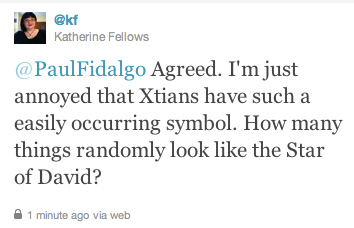
In addition to the Cross, other religious artifacts that will be displayed in the 9/11 Memorial Museum’s historical exhibition include a Star of David cut from World Trade Center steel and a Bible fused to a piece of steel that was found during the recovery effort.
In everyday context, these things are purely religious. In the context of the events of that day, as the American Jewish Committee’s Mark D. Stern told the New York Times, “It’s a significant part of the story of the reaction to the attack, and that is a secular piece of history.”
And so it is. I don’t like the idea one iota that in a time of great tragedy, people find their hope not necessarily in each other’s goodness, but in the notion that an invisible sky-emperor took the time not to save lives or change hearts, but to stick a couple of pieces of debris in the shape of a T. I wish with all my heart that people did not waste their energy and emotions on a being that is not really there and never will or can do anything for them.
But I don’t have to like it. The World Trade Center cross was there, and the people of New York divested it with meaning, and thus it became a character in the story of the 9/11 attacks. Its placement in the museum is not an endorsement of Christianity, it’s a page in that story. Whether I like that part of the story or not.
Update: Katherine Fellows makes an excellent point on Twitter, one which I wish I’d made myself.
-
The Food of Art
On last week’s Thinking Unenslaved podcast, we considered raising for discussion the topic of religion in the arts, and what might become of the arts if religion were not the force it is in our society and culture. We wound up not getting around to it, though I expect we probably will. Regardless, I had written up a few paragraphs to get the conversation started, and I thought I’d post them here. Remember, it’s intended to be the beginning of a conversation, not a complete thesis. But here you go.
A common form of fretting done by theists and atheists alike concerns anxiety over whether a religion-free society would be capable of producing great works of art, music, poetry, etc. Would we have Bach or Michelangelo without Christianity?
The question posed by our host before we began tonight was, “How would future societies replace the creative energies of religion in the Arts?” It presumes that a large enough percentage of quality art today is inspired by or derived from religious belief, and that its absence, in a vacuum, would leave a significant hole in our society’s cultural life, which I think it almost certainly not the case. Particularly if we’re talking not about less trite or less propagandistic art and media, but rather the kind of art that makes lives richer in the broadest sense. My confident guess would be that the vast majority of quality art and culture is produced without religion ever coming into the picture.
There were almost certainly times in human history when religion was a driving force behind wonderful visual art and music that will weather the centuries. But I don’t think this is so today.
But even if we grant the premise, that a lack of religious influence and inspiration would leave a great vacuum in our artistic and cultural life, I believe that vacuum is easily filled.
What we’re really talking about when we worry over this question is; what could possibly move the human heart to the degree that the wonder over the supernatural does? My answer: Plenty. First, consider the things that are already in place that move the human heart: love in all its forms (romantic, familial, etc.), idealism and deep belief in a cause, and despair, just to name a few.
But of course, these are not necessarily based on awe over something greater than oneself (but can be, I suppose), so the hole left by hypothetically-absent religion must be filled by something that satisfies that need. Well, lucky for the arts, humans are very small in the grand scheme of things. Earth is, too, as is our sun, our galaxy, and possibly even our universe. There is so much to ponder, so much to imagine when it comes to the workings of the cosmos and our place within it — and that encompasses the positive connotations of “wonder” as well as the feelings of insignificance or alienation. Even with no religion, the human heart cannot help but be stirred by such images, concepts, and questions.
And we need not even be so lofty: why not be awed by the ecosystem of our planet, the fact that civilization lumbers on despite our species’ missteps and greed, the potential for us as individuals and as a global society, the bonds of family and community. This just scratches the surface, but the point is, how can the artistic soul NOT be moved by such thoughts? How can the creative person NOT weigh in or react? If you ask me, these ideas are more full of wonder than any stories about fictional celestial superheroes and their meddlings in our lives.
So would we have Bach or Michelangelo without Christianity? Of course. Because artistic genius will not stay hungry. It will find its food of awe and wonder wherever it lies.
-
DADT and the Religious Right’s Clout
Jonathan Chait dissects the breach in Republican resistance to gay rights in the wake of the coming repeal of Don’t Ask Don’t Tell, and reaches an astounding side conclusion, emphasis mine:
The progress of gay rights in the United States over the last generation has been intoxicatingly rapid. It’s happening so fast that opponents, rather than fomenting a successful backlash, have mainly lost their desire to fight. In part this reflects changes in the Republican Party, which is now dominated almost entirely by defenders of the economic prerogatives of the rich and barely pretends to care about the Christian right’s agenda anymore.
What? Really? I dunno about that, sir. I might — might — buy into the notion that the organized Christian-Coalition-type political onslaught has lost some of its potency (some!), and if so, that’s mainly because the Southern strongholds for religious conservatives have essentially been established and heavily fortified for, I suspect, the next couple of generations at least, with no new territory to be won, only maintained.
But one can’t have witnessed the rise of the tea-bagger right and not have noticed that they, too, seem pretty crazy for the Jesus of Real America. They may not be as organized or have the kind of media sophistication of the major pressure groups, but they have passion and rage, a hair-trigger defensiveness about supposed attacks on their Christianness, and they don’t require any finessing to be made upset. If anything, this Christianist Mob that is currently posing as the Tea Party is more dangerous; angrier, dumber, and quicker to strike.
But yes, all Republicans really care about is the rich. The religious pandering is just a means to an end. But it is still one of the prime means.
-
Let’s Get More Humans
Jen McCreight has a very smart take on the issue of a lack of ethnic diversity among we seculars. The biggest problem in her mind is the denial that a problem exists by many within the atheistic ranks. Many dismiss it as a simple fact of the matter, and that to highlight minorities at things like conferences and in the media would be to, as one commenter put it, default to “second-rate” personalities in favor of the allegedly first-rate old white men (of whom, don’t get me wrong, I am also a big fan). Jen writes:
This is identical to atheism’s so called “women problem.” It’s not that we lack worthy non-white atheists: It’s that we have plenty of wonderful non-white atheists who we forget about. If you think people like Ayaan Hirsi Ali, Neil deGrasse Tyson, Maryam Namazie, Hemant Mehta, Ariane Sherine, Salman Rushdie, and Debbie Goddard are “second rate,” you are part of the problem.
Agreed. Jen is asking atheists to make an effort to be more inclusive, part of which is highlighting the above mentioned minority members (of our minority) — and not just because of their minority status but because they genuinely are first-rate.
But let me add to this. My sense is that many within our community who deny that this is a real issue do so because they think it’s merely P.R. If minorities want to be part of our weird little group, the logic goes, we’re certainly not stopping them. Jen responds thusly:
We’re not saying we need to go knocking on doors of religious minorities and target them for atheist evangelizing. We’re saying we want minorities who are already atheists to feel comfortable within our movement.
I’m not so sure. I think we do need to knock on doors (as it were). I think whatever is dissuading minorities from hanging with the godless needs to be addressed and overcome. That means current atheists and would-be atheists who haven’t been exposed to the right arguments and polemics. If it’s cultural barriers, social discomfort with an all-white group, or simple lack of awareness, those things can each be addressed on their merits. But it’s going to take folks within the movement to step outside and look for those in minority communities who don’t yet know they have a home with us.
It’s a very practical problem we have, and it’s a two-way loss — the atheist community is missing out on potential numbers, ideas, and input from folks of other demographic groups and cultural perspectives, and those groups are missing out on the important and liberating messages of the secular/atheist movement. What one commenter I saw on Facebook dismissed as a mere “lack of brown faces” is, I think, only the visible symptom of that greater problem.
P.R. is one thing, and it is a genuine concern. But the real problem is not the lack of faces, but the lack of hearts and minds from those groups, and that’s the problem that really shows one of our big weaknesses as a movement at this stage.
But really, it’s something we can solve. It doesn’t have to be this way at all. Let’s just not dismiss it as an annoyance or political correctness. We’re humanists, let’s get more humans.
-
Dreams from the Father?

I recently read Barack Obama’s Dreams from My Father, and it took a couple of weeks before something about it dawned on me. While Obama gained a lot of early national political credibility when he began to strongly advocate for more engagement with and embrace of faith in the Democratic Party, and often espoused his own religiousness and Christian-ness during the campaign, these themes seemed wholly absent from Dreams.
When Obama does deal with religion in the book’s narrative, it is almost exclusively raw pragmatism, figuring out how to harness existing religious institutions in Chicago and learning how to navigate their politics. To the best of my memory, at no point does Obama claim a “come-to-Jesus” moment in which he sees the proverbial light and converts from idealistic wanderer to committed Christian.
Perhaps this is more apparent in The Audacity of Hope, which, I have to admit, I have no inclination to read whatsoever. For while our president is obviously a very skilled and fluid writer, I am not inclined to use up my time on what from what I understand is essentially a campaign book, primarily published as an excuse for a by Rev. You-Know-God-Damn-America-Who, and I take it that it elaborates on his position on religious engagement Obama takes in his semi-famous 2006 Call to Renewal speech.
But it strikes me as interesting that his since-super-hyped Christianity is not apparent in Dreams. I suppose he could have had his Francis-Collins-meets-a-waterfall moment after having written the book, but somehow, I can’t help but think that Dreams serves as a truer foundation for where Obama is spiritually. The mysteries of the cosmos are too vast to be dealt with by mere mortals (“above his pay grade,” as it were), but only a stupid politician or community organizer would overlook the potential force behind an already-unified and malleable contingent of believers, and in the quest to do some good, not think to oneself, “I need to get them on my side.”
I’m not jumping on the Obama-as-closet-atheist bandwagon, because I see no evidence for it. But Dreams makes me suspect that if Obama is a Christian, it is more in the philosophical sense than in the theological. But, I stress, it is just a guess.
-
Armstrong’s “The Case for God”: A Case Not Made
Few religious thinkers have eased the consciences of spiritual liberals, anti-fundamentalist religious moderates, and functional nonbelievers unwilling to stake any affirmatively atheistic ground than Karen Armstrong. For years she has been making the assertion that her scholarship proves that the “great” monotheisms ought not be associated with the fear, xenophobia, irrational faith in the absurd, violence, or misogyny that so they so often encourage, but that they have their “true” foundations in love and tolerance–and anyone who doesn’t think so hasn’t been doing it right. As much as that assertion causes many skeptics to arch their eyebrows, it at least sounds like a good thing to which the faiths could aspire if they were so inclined. Alas.
Her latest book, The Case for God, is not meant to explain the various faiths’ dispositions or ideological foundations, but to convince the reader that the most commonly held notions of God, those of a being that created the universe and “exists,” are false, and that in actuality, God is an unknowable, unfathomable concept for which the very term “existence” is too limited. If you think that sounds like a pretty weak basis for an argument when dealing with such a grand concept’s veracity, you’re right. And despite Armstrong’s impressive breadth of knowledge and her nuanced grasp of various thinkers’ positions throughout the generations, her case never adds up.
Part of the trouble, of course, is that her book’s premise is challenged by her own explanation of what God is. It is nigh impossible for me to understand how someone can build a case for God if the central thesis is that God is an unknowable pseudo-entity-but-not-really, something that mere humans are wholly incapable of defining. Where does that leave your book?
One would hope that an intellect like Armstrong’s would note this paradox. Instead, she throws her lot in with apophatic explanations of God from a chosen slate of theologians, limiting the “correct” discussion of the nature of God to defining what Godis not. Thus, The Case for God is not so much a set of proofs for God’s existence, but a selection of and elaboration on the apophatic positions of particular religious thinkers, united in their unwillingness to pin God down to the realm of the perceivable. It is not a case, per se, but a series of similarly-themed guesses.
There is another paradox in Armstrong’s venture. Repeatedly throughout the book, she laments how “rationalist” notions of God (pretty much all of them since the Enlightenment, a period about which she seems to have mixed feelings) that picture a supreme being of some form that “exists” in the way most (okay, just about all) people define the term, and she is quite clear that such a position is flatly incorrect and–what might be the worst sin in her eyes–”idolatrous.” But by the very act of asserting that some notions of God are incorrect, she gives the lie to her position that God is an unknowable. If it is not, how can she know who is and is not correct in their beliefs?
Armstrong has a particular bone to pick with what we understand today as atheism, most vigorously with the New Atheists, who she says choose the idol-God of the incorrectly-religious to assert the non-existence of. But Armstrong herself, as many have pointed out before me, defines God out of all notions of existence anyway, leaving nothing to believe in to begin with. Speaking for atheists (if I may for the moment), I think it is safe to say that whether we are talking about a vengeful Old Testament Yahweh or a non-definable, quasi-existent infinite ultimateness of the divine logos, both are equally unprovable, devoid of evidence, and not worthy of acceptance. Like many of the New Atheists’ critics, she complains that they are not sufficiently well-versed in theology, and are therefor in no position to weigh in on the question of God’s existence. This is akin to saying that one cannot assert the nonexistence of the Starship Enterprise unless one has studied every episode of every Star Trek series, earned a degree in startrekology, and published scholarly articles on the debate as to whether resistance truly is futile.
To Armstrong, this rationalist line of thinking shuts out alternate means of arriving at “truths,” for Armstrong rests on the also-unprovable notion that truth is a fluid, utterly subjective concept that can be realized by means other than reason. This mindset obviously opens up a formidable can of worms, as any cockamamie “methodology” that someone chooses, and any absurd answers they turn up, suddenly become equally valid. For Armstrong, there is rational truth and religious truth, and religion–something she insists should be viewed as a discipline and practice rather than a belief system–is equally capable of arriving at truth as science. What truths religion is supposed to reveal is, of course, not terribly well defined, and one is forced to infer that the correct truths are those that Armstrong has revealed to us; God is too out-there for mere existence, thinking otherwise is wrong, and we should only talk about what God is not, though we’re pretty sure it’s all about love and tolerance. Throw in a few dashes of meaningless terms like “the infinite,” “ultimate truth,” “inner essences,” and things that have “no qualities,” and you have some idea of what Armstrong is talking about. Or, more likely, you don’t.
I would be remiss if this review did not also highlight what was particularly troubling about the book; Armstrong’s twisting of the practice of science to imply that at its best it is grounded in some theological inspiration. Armstrong praises those greats of ages past, Newton, Descartes, Kepler, and claims that they practiced a “science rooted in faith” because they were personally inspired by religious feeling to pursue knowledge. Now, it may very well be that all these men were driven to discovery out of religious fervor, but that does not in any way make the method they chose, the scientific method, somehow dependent upon or tainted by superstition. Their motivations may have been faith-based, their science was not, and could not have been. Her assertion otherwise is as meaningless as saying that their work was rooted in money if they were paid for their research. She also offends the sensibilities by looping in modern physicists who, since they often deal in invisible abstracts, are examples of science-as-faith-exercise. I would imagine that most of those physicists would balk at the idea of their work being classified as religious in this way.
And while she praises those scientists who have been open to the supernatural, she castigates Galileo for that same disposition. The difference is that Galileo was punished for his pursuit of actual truth, and that punishment was delivered by the earthly representatives of the ruling faith tradition. This is apparently an uncomfortable and inconvenient bit of history for Armstrong, as it is an instance in which religion actively suppresses and penalizes understanding of reality, and so she is careful to let us know that Galileoshares the blame with Pope Urban VIII for his house arrest and public shaming, because Galileo was “pe
rversely intent on reconciling” his scientific findings with scripture. This kind of faith-inspired science is perverse to Armstrong. Is it because he, unlike Kepler and Newton, was punished for it by the ministers of that very faith?There is more to be said about Armstrong’s puzzling take on the purpose of religion; something of a set of rituals designed to make one a better person in some undefined way, the vaguest kind of self-improvement. But if every believer on Earth were religious in the Armstrongian sense, there probably wouldn’t be too much of a need for affirmative atheism or a secularist movement. Goodness knows, she has won the congratulations of the fuzzily-spiritual and not-quite religious all over the mainstream press, particularly from liberals. But her God is as flimsy of a hypothesis as any other more “idolatrous” version, whether she would deign to allow her position to be subject to such earthly terms as “hypothesis” or not. The case for God is not only a weak one, but it is, like Armstrong’s own God, for all intents and purposes non-existent.


 pav dot quest